Manage the suppression list
The suppression list is the record of every address ColdMerge will not send to, and why. Open it under Contacts, then the Suppression tab.
Above the table sits the count: “1,240 addresses you’ll never email.”, or “Nobody yet.” if the list is empty.
Look up one address
Section titled “Look up one address”The Look up an address box takes one whole email address.
Type the complete address. A partial never matches. Searching for acme will
find nothing even if [email protected] is on the list.
That is a consequence of how the list works rather than a missing feature. Addresses are matched by a one-way hash, and a hash cannot be searched by fragment. An exact match is also the only search that an erased row can answer at all.
The empty result says so plainly: “No exact match”, followed by “A partial
address never matches, so this doesn’t mean <what you typed> can be emailed.”
Add addresses
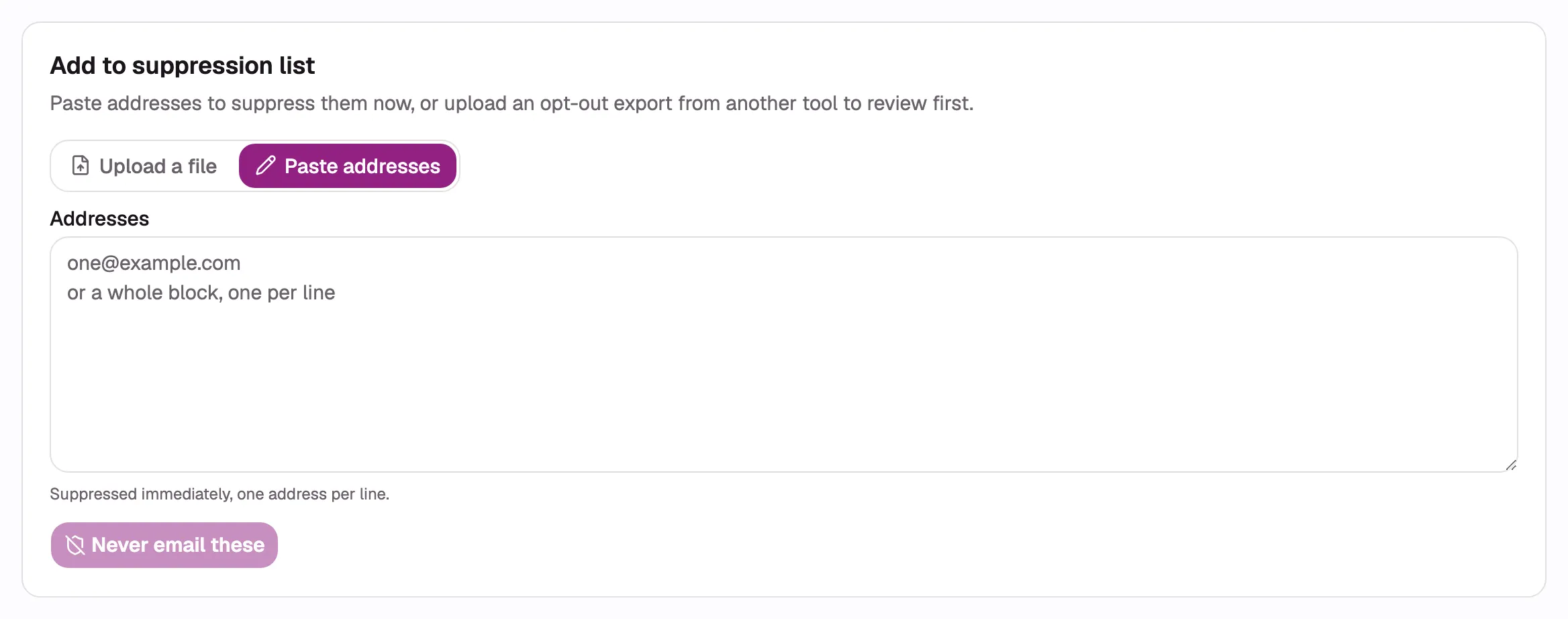
Section titled “Add addresses”One card at the top, Add to suppression list, holds both ways in. It has two tabs, and the button changes with the tab you are on.
Paste addresses
Section titled “Paste addresses”This is the default tab, and the everyday one.
- Paste addresses into the box, one per line.
- Select Never email these.
They are suppressed immediately. There is no review step, because an address is a block of one and there is nothing to map.
Any line that is not an email address stays on screen underneath, listed with its line number, so you can see exactly which ones to fix. Up to ten are shown, then “and N more”. They stay put rather than flashing past in a toast, because these are the lines you have to go and correct.
The confirmation tells you the split, for example “12 addresses added, 3 already on the list.” If nothing at all was an address, it says so instead of claiming success.
Upload a file
Section titled “Upload a file”Use this tab for an opt-out export from a tool you are moving away from.
- Switch to Upload a file.
- Drop the file on the dropzone, or select it to browse. The hint under the box states the accepted file types and size limit.
- Select Read the addresses.
The file is staged as a suppression import and you land in the ordinary import wizard, the same one contact imports use. See Contacts, lists & imports for how that screen works.
A suppression import has no column mapping and no target list, so there is nothing to configure. Go straight to applying it. In the summary afterwards, the created count reads Suppressed rather than “Added”.
A migration of years of opt-outs takes minutes, and it is the kind of thing you start and walk away from. Past imports, next to the button, takes you back to one already running.
Read a row
Section titled “Read a row”Each row carries the address, a short explanation, the reason, the source, and the date it was added.
The whole row reads as ordinary neutral text. Nothing on this screen is red. Being on this list is the system doing its job.
Reasons
Section titled “Reasons”| Reason | What happened | Can it come off? |
|---|---|---|
| Unsubscribed | They used the unsubscribe link in a message you sent. | Never |
| Bounced | Their mail server rejected a message as undeliverable. | Yes |
| Added by you | You put this address on the list, by hand or by importing it. | Yes |
| Erased | They asked to be erased, so everything but the one-way hash is gone. | Never |
The explanation under each address says both halves in words, so you never have to guess which rows are permanent.
Sources
Section titled “Sources”The source column says where the row came from.
| Source | Meaning |
|---|---|
| Unsubscribe link | A recipient opted out of a message you sent. |
| Bounce report | A mail server reported the address as permanently undeliverable. |
| Added by hand | Typed or pasted on this screen. |
| Imported | Came from a suppression file you uploaded. |
| Suppressed from contacts | Selected on the Contacts screen and suppressed in bulk. |
| Not recorded | An erasure row, which deliberately records no provenance. |
Remove a row
Section titled “Remove a row”The Removal column on the right holds one of three things.
- A Remove button, if the row can come off and you are an Owner or Admin.
- A sentence explaining why the row cannot come off, if it cannot.
- Nothing at all, if the row could come off but your role does not allow it.
Selecting Remove asks you to confirm, naming the address: “Let
[email protected] be emailed again?” with the note “Your campaigns will send to
[email protected] again.” Confirm, and it is off the list.
Who can remove
Section titled “Who can remove”Adding to the list is open to any role. It is the ordinary work of outreach.
Removing is Owner and Admin only. Undoing a suppression is a compliance decision, so it sits with the roles that make compliance decisions.
A Member does not see a disabled button on a row they cannot act on. They see nothing there. A greyed-out control with no explanation is something people argue with, so ColdMerge leaves it out.
Rows nobody can remove
Section titled “Rows nobody can remove”Two kinds of row are refused for every role, including Owners.
Unsubscribed rows. The row reads: “This person clicked unsubscribe. Nobody can put them back on your sending list, at any Role: they asked you to stop.”
Erased rows. The address column shows the word erased in muted italics instead of an address, because the plaintext is gone. The refusal reads: “This address was erased at the person’s request. The one-way hash is all that is left of them, and it is the only thing keeping the next import from re-creating them.”
An erased row keeps whatever reason it had before the erasure, so a row can read Bounced and still be unremovable. What decides it is whether the address is still there, not what the reason column says. If the address is gone, so is the Remove button.
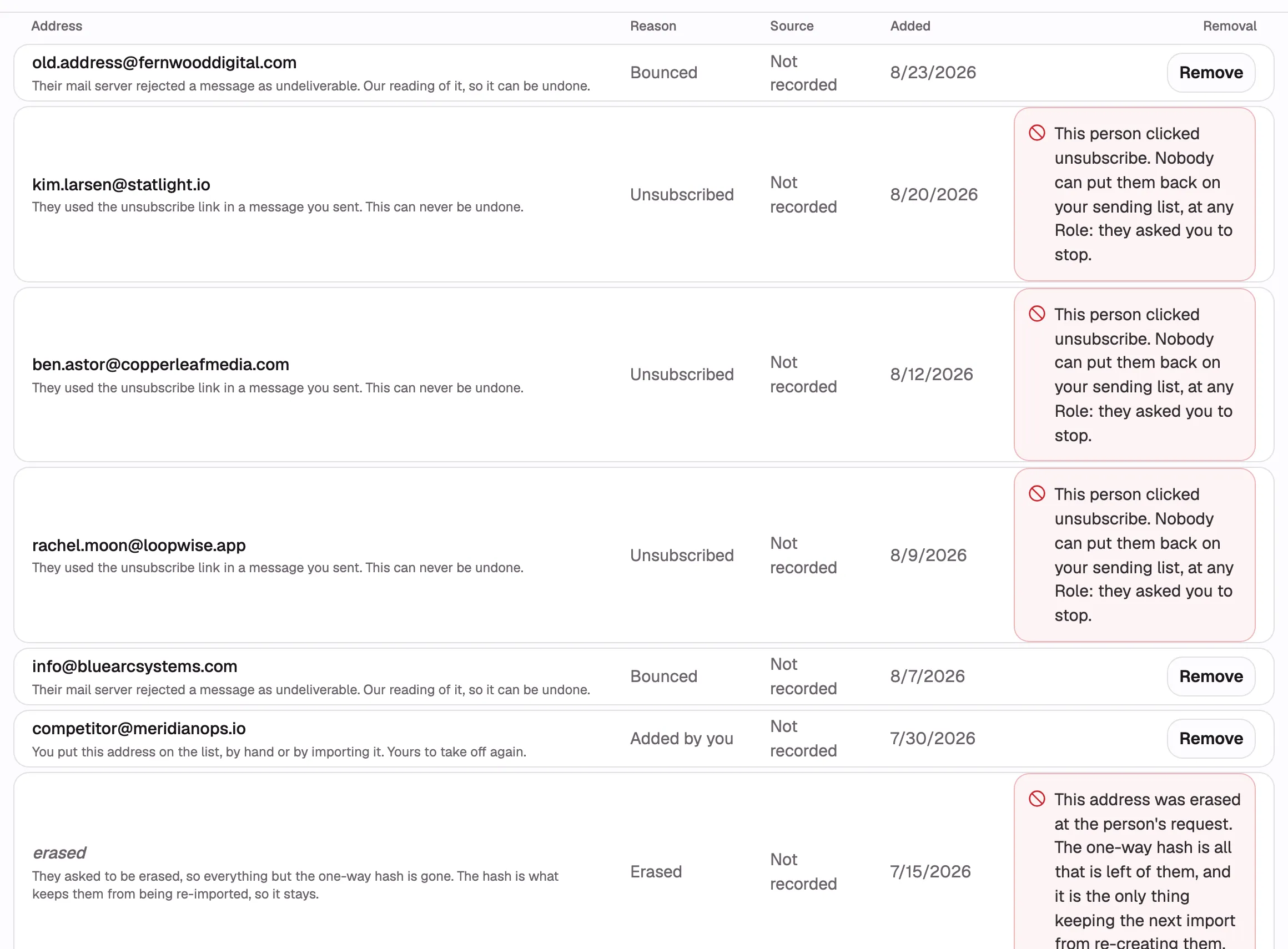
The refusal text you read is the same sentence the server would answer with, so there is never a case where the screen offers something the system would refuse, or hides something it would have allowed.
Adding the same address twice
Section titled “Adding the same address twice”Nothing breaks. The row already there is kept, along with its original reason and date. The first record of why an address is on the list wins, and a second write never overwrites it.
So pasting a list that overlaps one you imported last month is safe, and the confirmation tells you how many were already there.
What suppression does to a running campaign
Section titled “What suppression does to a running campaign”Suppression is account-wide and enforced on every send, with no exceptions.
- Nobody suppressed receives another message from any campaign.
- Any follow-up steps still waiting for that person are ended.
- At import time, a suppressed address is skipped entirely: no contact is created, no fields are updated on an existing one, and no list membership is added.
That import-time skip is hygiene rather than the guarantee. The real guarantee is the check at the moment of sending, because somebody can become suppressed after you imported them.