Email verification
Verification checks whether an address is likely to accept mail, before you spend a send on it. A bad address costs you twice: the send is wasted, and the bounce damages the reputation of the mailbox it went from.
ColdMerge checks addresses on demand, charges you only when it gets an answer, and does one thing that may surprise you: it never removes anyone from your list, whatever the verdict says.
The four verdicts
Section titled “The four verdicts”Every answer is one of four values.
| Verdict | What it means |
|---|---|
| Alive (Valid) | A real mailbox. Safe to send |
| Dead (Invalid) | The address will bounce |
| Risky | Real but dangerous: catch-all domains, likely spam traps, known complainers |
| No-answer | The checker could not decide. Not really an answer at all |
There is a fifth state, and it is not a verdict: Not checked. It is simply the absence of any result, shown as plain text rather than a badge, because nothing has been claimed about that address yet.
Risky deliberately folds several different provider results into one word. A catch-all domain accepts everything, so nobody can tell you whether that particular mailbox exists. A spam trap is a real address planted to catch senders who bought a list. A known complainer marks people as spam. Different causes, one piece of advice: proceed carefully.
What each verdict costs
Section titled “What each verdict costs”One credit is spent per answer, where an answer means Alive, Dead, or Risky.
| Outcome | Credits |
|---|---|
| Alive | 1 |
| Dead | 1 |
| Risky, including catch-all | 1 |
| No-answer | 0 |
| A checker error on one address | 0 |
| An address already on your suppression list | 0 |
| An address that is obviously not an address | 0 |
| An address checked recently enough to reuse | 0 |
The rule behind the table: you never pay for a result you cannot use. A no-answer is not a result, so its reserved credit is released back to you. A whole run that fails charges nothing at all.
Two of those free cases happen automatically before any credit is reserved. Anything already on your suppression list is skipped, because you are not going to email them anyway. Anything with obviously broken syntax is marked dead for free, because that needs no checker.
A catch-all result does bill one credit. It maps to Risky, which is a real answer, and answers cost a credit.
Verification informs, it never suppresses
Section titled “Verification informs, it never suppresses”This is the most important thing on this page.
The reason is straightforward. Your suppression list is a compliance record. An unsubscribe or an erasure on that list can never be removed, and it should not be, because a person asked you to stop. A verification verdict is not that. It is a third party’s guess, made before any mail was sent, and third parties are sometimes wrong.
One wrong “dead” would permanently condemn a genuine prospect if it fed the same list. So it does not. Only hard facts, a real bounce or a real unsubscribe, add anyone to suppression. See unsubscribes and suppression.
What the verdicts do at launch
Section titled “What the verdicts do at launch”Verdicts inform the launch review, and you always keep the final say.
- Dead recipients are left out by default. The review says so in plain words, and offers Send to them anyway as a single click. The screen restates the rule under the buttons: skipping the dead is the default so a bad address never costs your account, and including them suppresses nobody.
- Risky recipients are still sent to, and flagged in the review summary.
- No-answer recipients are still sent to.
- Not checked recipients are still sent to.
Nothing about verification can stop a campaign. See launch a campaign.
Results are shared and they go stale
Section titled “Results are shared and they go stale”A result is stored against the address, not against a contact. Once an address has been checked and paid for, that answer is reused everywhere the same address turns up: another import, another list, another campaign. You are not billed twice for the same address.
Results do not last forever. Mailboxes get closed and people leave companies, so an old answer stops being trustworthy. After roughly three months a result is treated as stale: it stops counting as verified and becomes eligible to be checked again. The exact window is a setting that can change, so treat it as “about three months”, not as a promise.
That is why two counts on the campaign Check step rarely match. “Never checked” counts addresses with no result at all. “Can be checked now” counts what a check would actually bill for, which includes stale results and leaves out anything that can be reused for free.
Where verification appears
Section titled “Where verification appears”Verification is not a separate silo. It shows up wherever you are about to send.
The Verification area has three tabs and one persistent Add contacts to verify action in its header:
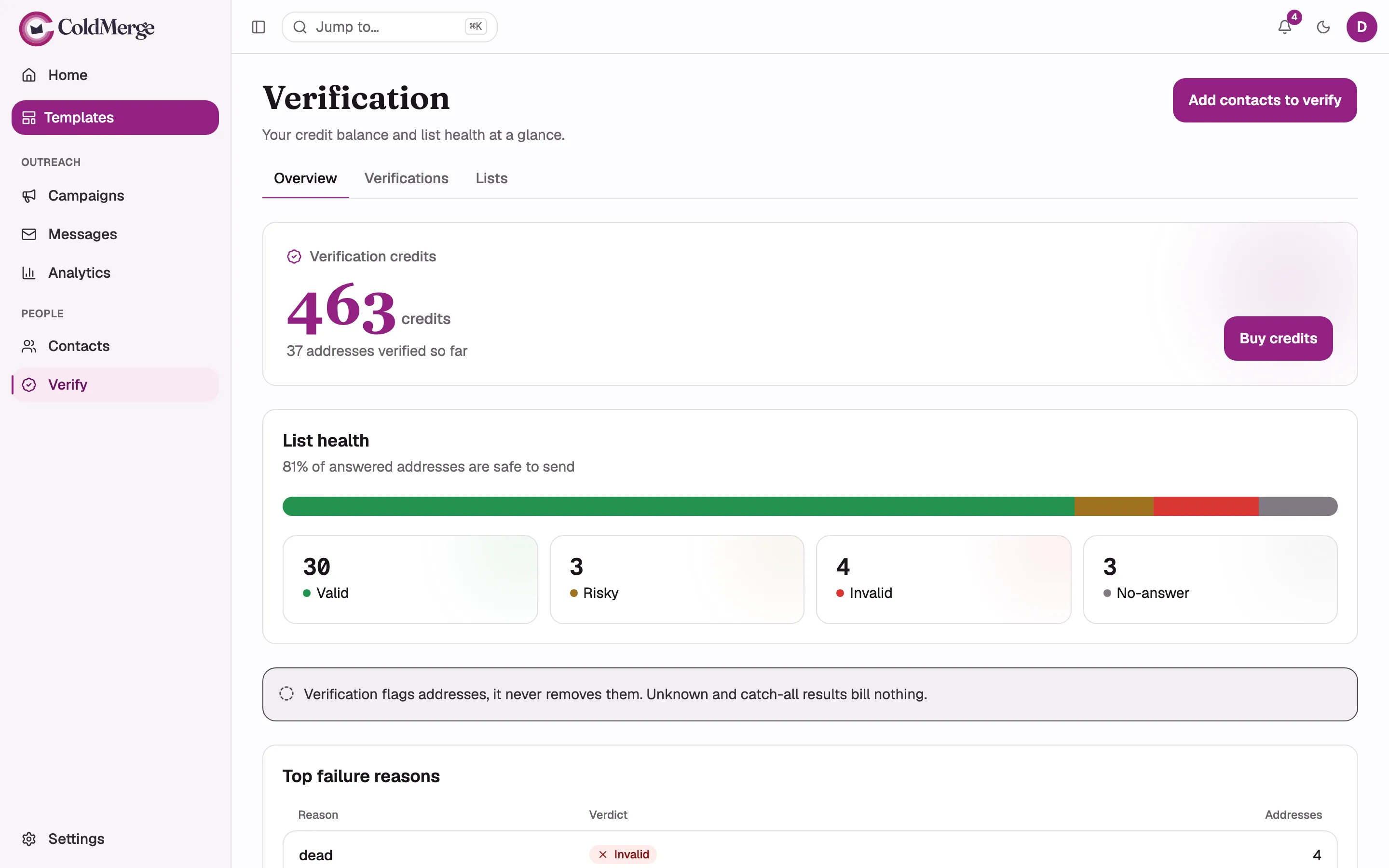
- Overview shows your credit balance, a health bar and four verdict tiles across everything you have checked, your top failure reasons, and the most recently checked addresses. A fixed note repeats the two stances: verification flags addresses, it never removes them, and unknown and catch-all results bill nothing.
- Verifications is the history of every check you have run. See verification credits and runs.
- Lists is your lists with a health lens: a health pill per list, and a Verify action on any list that has never been checked. Only active lists appear, because an archived list is never a send target.
The same check offer also appears at each point where addresses arrive or leave:
- The import wizard, right after you add contacts.
- A list’s detail screen, and the health cell in any lists table.
- A campaign’s Check step, before you launch.
Wherever it appears, it looks the same: a free count of who could be checked, one button, and a confirmation that reads back the numbers before anything is spent.
Verification never runs on its own
Section titled “Verification never runs on its own”No check ever starts automatically. Not on import, not at launch, not on a schedule. A run begins only when you select the button and confirm a quote that shows the count, the cost, your balance, and any shortfall.
That is the same stance as the rest of the product: the cost is shown before the spend, every time.
Privacy
Section titled “Privacy”A verification result is personal data, so it is treated as such. When you erase a contact, their verification result is dropped outright and nothing about it is kept. That is different from suppression, which keeps a one-way hash so an erased person can never be re-imported and re-emailed.