Launch a campaign
Pressing Continue to review on a draft opens the launch wizard. The campaign moves to the Review status. Nothing sends. ColdMerge works out who this campaign would reach and what it would skip, and shows you the numbers you are about to commit to.
The wizard has three steps: Check, Audience, and Review. You can move between them freely. There are no hard gates.
Launching is done on a computer.
Step 1: Check your list
Section titled “Step 1: Check your list”This step is about whether the addresses are real.
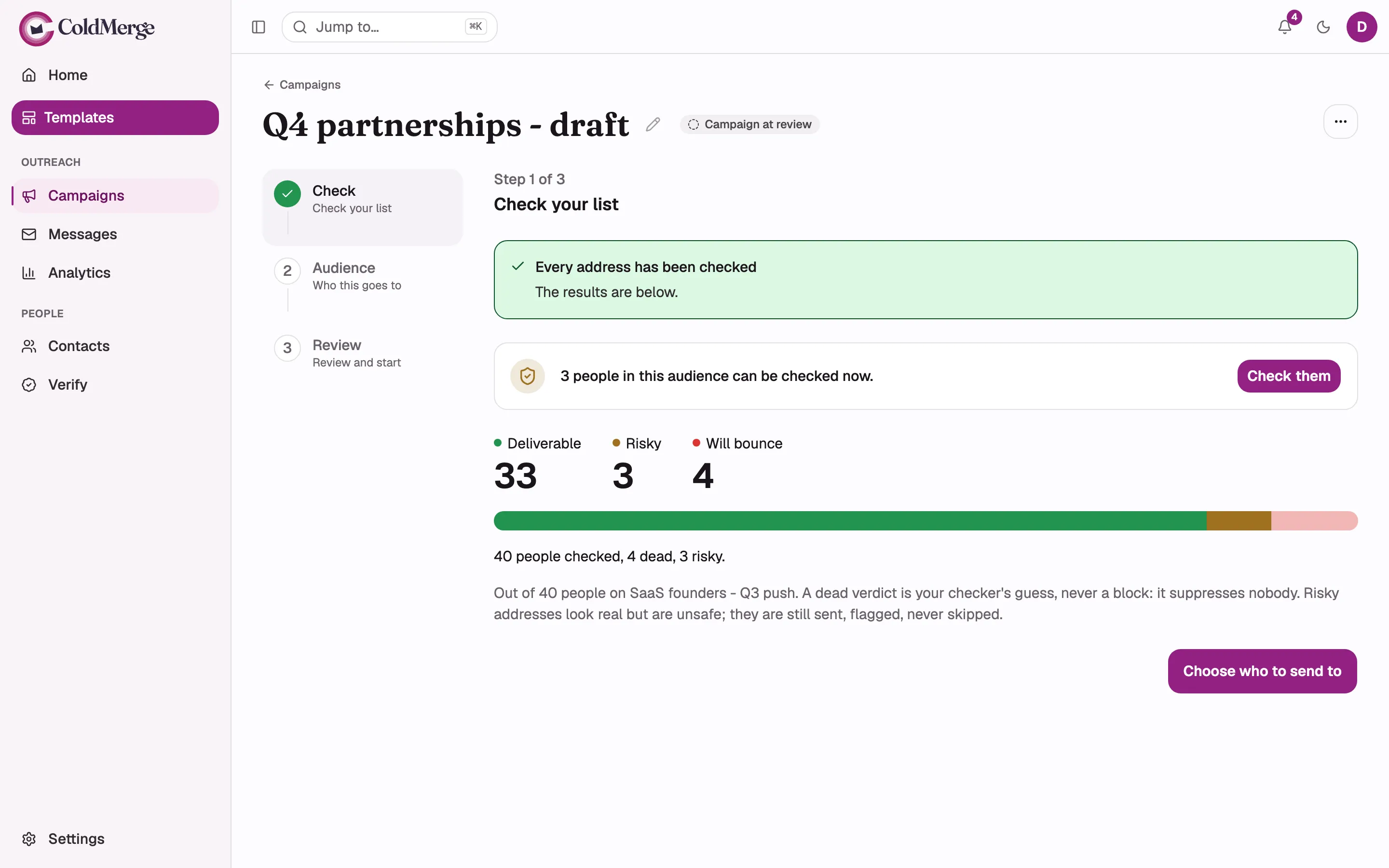
If nothing has been checked yet, you see a line reading “N people in this audience can be checked now.” Pressing the button starts a verification run. If everything has already been checked, you see the notice “Every address has been checked”.
The button reads Check them, and pressing it spends nothing yet. A confirmation opens first stating the exact cost, in the form “Checking 120 people costs 120 credits. No-answer checks are never charged.” If your balance covers only part of the audience, the same dialog says how many it will check and how many need a top-up, and its confirm button becomes Check the first N. Credits are only spent after you confirm.
Once there are results, four numbers appear with a bar underneath:
| Number | Means |
|---|---|
| Deliverable | A real mailbox. Safe to send. |
| Risky | Real but dangerous. A catch-all, a spam trap, or a known complainer. |
| Will bounce | The check says this address is dead. |
| Not checked | No result at all. Not a verdict, just an absence. |
Step 2: Who this goes to
Section titled “Step 2: Who this goes to”This step is about who gets left out, and whether you agree. Each choice appears only if there is something to decide about. Whichever button is filled in is the choice currently in force, and every choice is recorded with who made it and when.
Missing a merge field
Section titled “Missing a merge field”Some contacts have no value for a token your message uses, and the token has no fallback. Three options:
- Add a fallback. Sends the campaign back to draft so you can write
something like
{{company | your team}}. This is the only option that produces good mail, so it is the one to reach for first. - Skip those contacts. They are left out of this campaign. This is the recommended default.
- Send anyway, with the tokens empty. They are emailed with a gap where the value would have been.
See the merge token reference for the fallback syntax.
Already queued in another campaign
Section titled “Already queued in another campaign”Some of these people are already waiting in another live campaign. Two options:
- Skip them here. The default, so a double send is never an accident.
- Send to them anyway. For when the overlap is deliberate.
Flagged dead by your check
Section titled “Flagged dead by your check”Some addresses came back dead from verification. Two options:
- Skip the dead ones. The default, so a bad address never costs your account.
- Send to them anyway. A dead verdict is a checker’s guess, so this is always one click away. Including them suppresses nobody.
Auto-sync
Section titled “Auto-sync”The Auto-sync panel decides what happens to people added to the list after you launch. The toggle reads Keep enrolling new people added to this list, and it is on by default.
While it is on, a contact added to that list later flows into the running campaign. They go through exactly the same checks the launch used, then join the queue or are skipped with a reason.
Two things to know:
- Sync is one-way and additive. Removing somebody from the list does not retract anyone already queued or already emailed. To stop mail to one person, cancel their recipient row or suppress them.
- You can turn auto-sync off later while the campaign runs. Turning it off never removes anybody already enrolled.
Step 3: Review and start
Section titled “Step 3: Review and start”The last step leads with one big number: how many people will be emailed, out of how many are on the list. Under it, the line “Nothing sends until you start or schedule below.”
Below that is Everything you set up, a recap of the list, the mailboxes, the subject, the verification summary, and the sending window. Then the message itself, the follow-up steps read-only, a preview of the members, and the recipients table.
Read the recap. This is your last look before real mail goes out.
Start now
Section titled “Start now”Start sending now starts the campaign immediately. “Immediately” still means inside the sending window, so if the window is shut the campaign waits for it to open.
Start later
Section titled “Start later”Start later opens a calendar and a time. The campaign holds until that instant, then the sending window still governs the first send. The time you pick is a floor, never an override.
That means “start Saturday” against a Monday to Friday window resolves to the following Monday. After you confirm, the campaign shows the resolved first send time, so you always see when it truly begins rather than the moment you typed.
Change your mind
Section titled “Change your mind”Delete campaign abandons a campaign at review. Nothing was sent, the planned recipients are discarded, and your list and contacts are untouched. This is the one consequential control that also works on a phone.
Once a campaign reaches sending, deleting is gone and Cancel campaign takes its place.
What the launch freezes
Section titled “What the launch freezes”Confirming freezes exactly two things:
- The audience, meaning the list of recipients as computed. The list you aimed at can no longer be changed.
- The first email, from the moment the very first send actually goes out.
It deliberately does not freeze your contacts’ data for this email. The campaign’s own message renders from the live contact at the moment it is sent, so a correction you make on day one does reach somebody sent to on day three.
The review counts describe the cohort as of launch. Because contact data is not frozen, somebody counted as missing a merge field at review can still send successfully later if you fill the field in before their turn comes.
Follow-up steps are not frozen either, but a person’s merge data is. It is captured when they are enrolled, which happens at their first send, so a correction you make after that never reaches their follow-ups. See How follow-up sequences work.
What you can still change afterwards is on Monitor and control a running campaign.