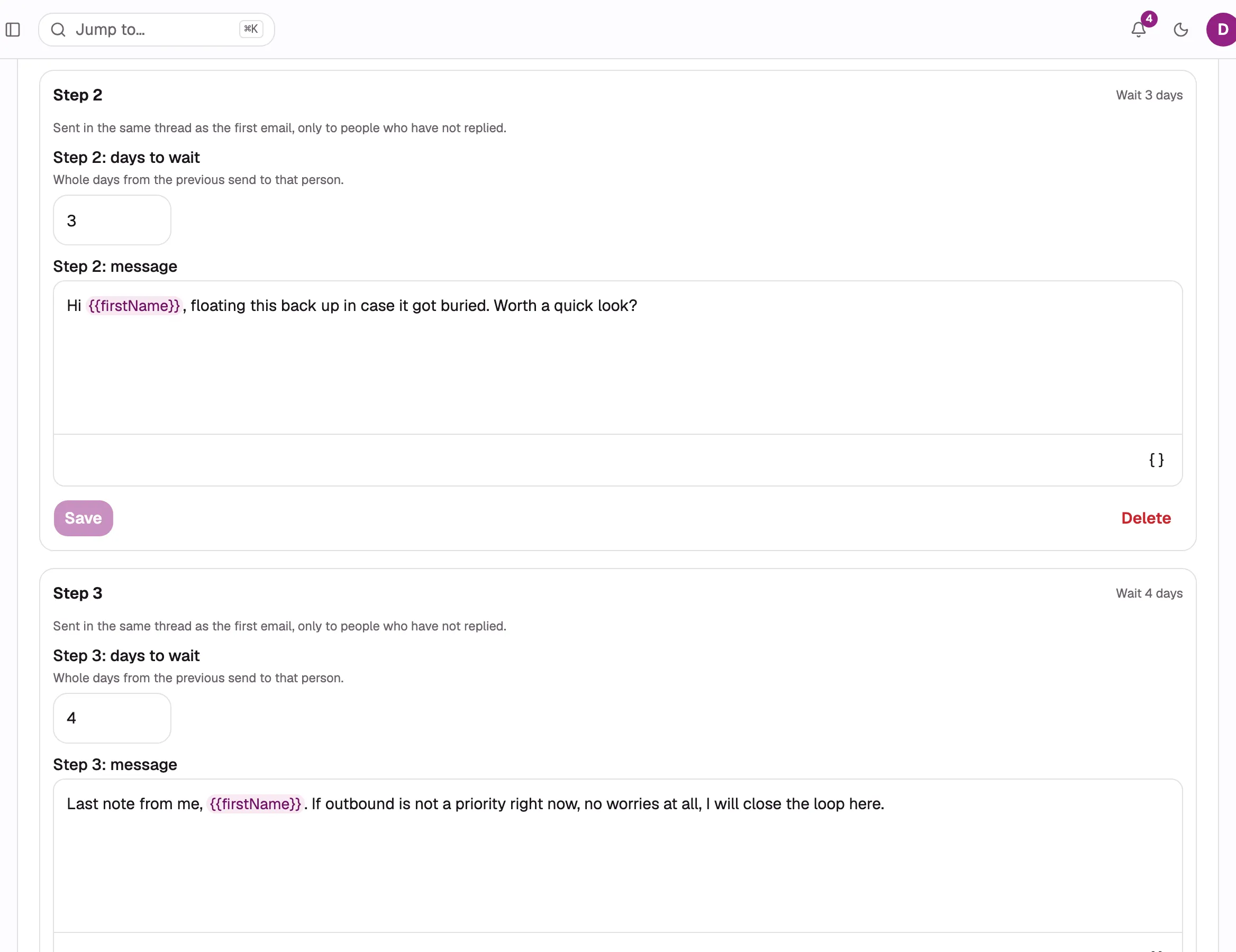
How follow-up sequences work
A sequence is a campaign’s ordered follow-ups. It is not a separate thing you build and then attach. The steps belong to the campaign that sends the first email, and they are edited in the Follow-ups card under the message.
Step 1 is the first email
Section titled “Step 1 is the first email”The numbering counts the campaign’s own email as Step 1. So the first follow-up you add reads as Step 2, the next as Step 3, and so on.
This trips people up, so it is worth saying plainly: adding one follow-up gives a person two emails, not one extra plus the original counted separately.
You can add up to 8 follow-ups, which is 9 emails in total including the first.
The wait
Section titled “The wait”Each follow-up carries one number: how many whole days to wait. The card reads “Wait N days, then send in the same thread”.
- The minimum is 1 day.
- The wait counts from the previous send to that person, not from launch and not from any fixed clock time.
- When the wait is up, the follow-up still waits for the campaign’s sending window to be open, and still queues behind the mailbox’s daily budget.
So a 3 day wait means “no sooner than three days later, then at the next sensible moment inside the window”.
Waits are per person, not per campaign. Two people who got the first email a week apart get their follow-ups a week apart.
Everything rides one thread
Section titled “Everything rides one thread”A follow-up is always sent as a reply in the same Gmail thread as the first
email. That is why a follow-up has no subject field of its own. Its subject is
derived as Re: plus the subject the first email actually sent with, including
whatever the merge tokens rendered for that person.
The same mailbox sends every step. A contact is bound at their first send to one connected account for the whole sequence, so the conversation stays in one inbox and their replies come back to the right place.
The one case with no follow-ups
Section titled “The one case with no follow-ups”Sometimes ColdMerge sends the first email but never learns the Gmail thread it landed in. When that happens, that person is enrolled in nothing. They get the first email and no follow-ups, quietly and on purpose. ColdMerge does not follow up on a conversation whose replies it cannot see.
You can spot it in the Recipients table, where that person reads “Sent, but no follow-ups: reply thread unavailable”. It is rare, and it is not an error.
What stops a sequence
Section titled “What stops a sequence”| What happens | What it stops |
|---|---|
| The person sends a genuine reply | Only this campaign’s follow-ups to that person. The same person in a different campaign keeps hearing from it. |
| An out-of-office or other auto-reply arrives | Nothing. Follow-ups continue. |
| The address hard bounces | Every live sequence for that person, everywhere, and marks them undeliverable. |
| The person unsubscribes, or you suppress them by hand | Every live sequence for that person, across your whole organization. |
| You cancel the campaign | That campaign’s sequence, for everyone still in it. |
The “if no reply” condition is built in, with nothing to configure and no branches. Version 1 sequences are strictly linear: step 1, wait, step 2, wait, step 3.
One precondition, and it is set at connect time. Reply detection needs the “Read your Gmail” permission, which is optional. A mailbox connected without it cannot see replies, so nothing in the first row of the table above happens for it. See what each permission is for.
A reply is checked twice, once the moment it is classified and again just before the next follow-up is handed to Gmail, so a reply that lands seconds before the send still stops it.
Frozen data, editable steps
Section titled “Frozen data, editable steps”Two things behave differently, and the difference matters.
A person’s merge data is frozen when they are enrolled. Their follow-ups render from that snapshot.
The steps themselves are not frozen. You can change a follow-up’s body, its wait, add a new one, or delete one, for the whole life of a running campaign. Whether a follow-up is due is worked out from the current list of steps every time, not from anything stored, so shortening a wait applies to everyone still waiting on it.
The follow-up card is editable while the campaign is in draft, review, sending, or paused. Once the campaign is completed or cancelled the card is read-only.
Format is decided by step 1
Section titled “Format is decided by step 1”A follow-up carries no format of its own. The whole sequence inherits the body mode from the first email.
This is a sharp edge worth remembering: formatting text inside a follow-up while the first email stays plain does not flip the campaign to HTML. Only the first email, or turning on tracking, decides the format for every step.
Attachments are the same story. They ride the first email only and never the follow-ups.
Add a follow-up
Section titled “Add a follow-up”- Open the campaign and scroll to the Follow-ups card, under the message.
- Press Add a follow-up email.
- Set the days to wait, then write the body.
- Press Save on that card. Each follow-up saves on its own.
Follow-ups are authored on a computer. On a phone the card shows the sequence read-only.