Open and click tracking
Open and click tracking is off by default in ColdMerge, and this page will not try to talk you into it. Open rate in particular is a weak signal that got much weaker, and the product says so on the toggle itself: “Unreliable and detrimental.”
Read this page, decide, then turn it on for the campaigns where you genuinely need engagement data.
What tracking actually does
Section titled “What tracking actually does”Click tracking rewrites each link you wrote in the body so it points at your tracking domain first. When someone selects the link, that address records the click and forwards them straight to the real page. The destination always comes from the link ColdMerge stored when the campaign was built, never from anything in the request, so a tracking link cannot be tampered with to send someone somewhere else.
Open tracking puts a single transparent 1x1 pixel image in the message, served from the same tracking domain. When a mail client loads that image, ColdMerge records an open.
Both need a tracking domain of your own. See set up a tracking domain.
What tracking cannot tell you
Section titled “What tracking cannot tell you”Be clear-eyed about the ceiling on this data.
- An open is not a read. It means something loaded an image. Nothing more.
- Apple Mail Privacy Protection loads the pixel for people who never opened anything. On Apple Mail, opens are inflated, and you cannot tell the real ones apart from the automatic ones.
- Many clients block images by default. A person can read your whole email carefully and never register an open at all. So opens are inflated in one direction and missed in the other, at the same time.
- Security scanners and link checkers click links. Corporate mail filters routinely fetch every link in a message before the human ever sees it, which can produce a click nobody made.
- A pixel can hurt deliverability. A tracking image and rewritten links are patterns spam filters recognise.
This is why ColdMerge leads with reply rate. A reply is a human being answering you. It needs no tracking domain, no pixel, and no rewritten links, and it cannot be faked by a scanner.
What ColdMerge records, and what it refuses to
Section titled “What ColdMerge records, and what it refuses to”A tracking event holds four things: which message it belongs to, whether it was an open or a click, when it happened, and, for a click, which link in the body it was.
The token inside a tracking link identifies the message and the link position. It does not carry your recipient’s email address, so the link itself gives nothing away about who it was sent to.
And one link is never rewritten under any circumstances: the unsubscribe link, along with the invisible unsubscribe header. Opting out is never tracked and never routed through anything. See unsubscribes and suppression.
How repeat opens and clicks are counted
Section titled “How repeat opens and clicks are counted”Tracking counts messages, not events.
The first open of a message is recorded. If the same message is opened again, or a scanner fetches the pixel, or a mail client prefetches it, those all collapse onto that first record. The timestamp stays at the first one. The same holds for a click on a given link: the first click on that link in that message is kept, and repeats collapse into it.
On Analytics, the Opens figure is the number of messages with at least one open, and Clicks is the number of messages with at least one click.
So the numbers answer “how many of my emails got opened at least once”, not “how many times were my emails opened”. That is deliberate. A count of raw events would move whenever a scanner ran twice, and would tell you nothing extra.
Tracking requires HTML
Section titled “Tracking requires HTML”A tracking pixel is an image, and a rewritten link needs a real link to rewrite. Neither exists in a plain-text email. So tracking is available only for campaigns sent as HTML.
You never pick HTML directly in ColdMerge. The composer decides: format anything in the body and the campaign sends as HTML, otherwise it sends as plain text. Turning on either tracking toggle is itself one of the things that makes the campaign HTML. See write your campaign.
Turn tracking on for a campaign
Section titled “Turn tracking on for a campaign”Tracking is per campaign, and both toggles start off.
- Open the campaign.
- Find the Track emails row in the campaign’s settings. Its value reads On or Off.
- Select it. A panel opens.
- Turn on Track link clicks, Track opens, or both.
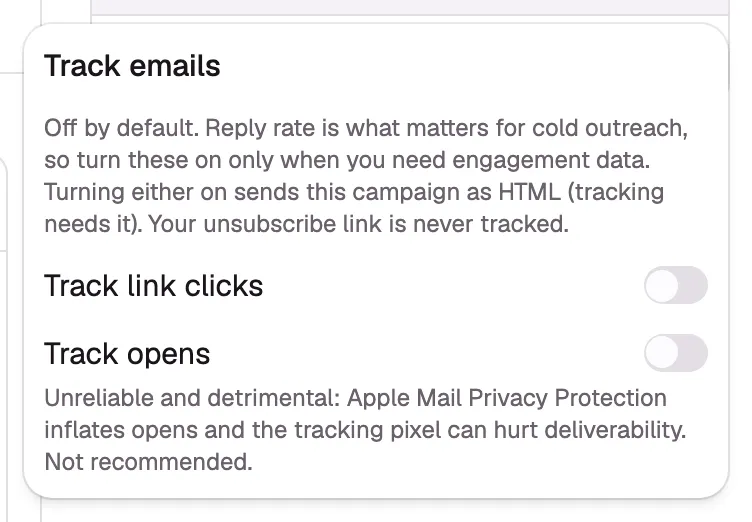
The panel spells out the trade in one line: off by default, reply rate is what matters for cold outreach, turning either on sends this campaign as HTML, and your unsubscribe link is never tracked. The open toggle carries its own warning underneath about Apple Mail and deliverability.
If you have no tracking domain yet
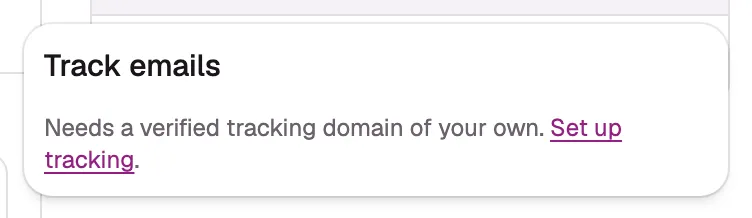
Section titled “If you have no tracking domain yet”The panel does not disappear. It explains why the toggles are not there: “Needs a verified tracking domain of your own”, with a Set up tracking link straight to the setup screen.
The toggles freeze at the first send
Section titled “The toggles freeze at the first send”Tracking settings belong to the group of campaign fields that can be changed only until the very first email actually goes out. After that they are fixed for the life of the campaign. Decide before you launch.
Where the numbers appear
Section titled “Where the numbers appear”Opens and clicks appear in their own section on Analytics, below the reply, bounce, and unsubscribe numbers. That position is on purpose: a secondary signal, never the headline.
If tracking has never been turned on for any campaign, that section shows a notice reading “Tracking is off” with the line “Turn it on per campaign to populate this row.”