Bounces and the circuit breaker
A bounce is a receiving mail server telling you that an address does not exist. One or two is noise. A steady stream is the single loudest signal that you are sending to a list you should not be sending to, and it is the signal most likely to cost you your Google account.
This page explains what ColdMerge measures, what it does about it, and why the one automatic stop in the whole product lives here.
What a bounce rate means
Section titled “What a bounce rate means”Your bounce rate is the share of your sends that came back as permanently undeliverable.
Only permanent failures count. A mail server saying “mailbox full, try later” is
a temporary condition and does not mark anyone undeliverable. A server saying
“no such user” is permanent, and that contact is added to your suppression list
with the reason bounce so nothing sends to them again.
Some context for the number:
- Under about 3% is what a clean, recently-built cold list looks like.
- 5% and up is elevated. ColdMerge badges it, and does nothing else.
- 10% and up is high, and it is the line where the circuit breaker trips.
A high bounce rate is almost never a sending problem. It is a list problem. It usually means the list is old, was scraped, or was bought. Addresses decay constantly as people change jobs.
The passive layer: warn, never block
Section titled “The passive layer: warn, never block”Anywhere ColdMerge shows a bounce rate (a campaign, a mailbox, your workspace home) it also shows a small badge when the rate is elevated: “Elevated” at 5% and up, “High” at 10% and up.
That badge does exactly nothing else. It does not pause, throttle, or restrict you. It is there so an elevated rate is impossible to miss while you keep the decision.
The hard layer: the circuit breaker
Section titled “The hard layer: the circuit breaker”There is one exception to warn-never-block, and it is deliberately narrow.
A campaign auto-pauses when at least 10% of its trailing last 200 sends bounced, and this is only evaluated once at least 100 of those 200 sends are old enough to have resolved one way or the other.
Each piece of that rule is doing a job.
The trailing 200 means the rule reacts to how the campaign is behaving now. A campaign that hit a dirty patch early and recovered is not held hostage by history.
The 100 resolved minimum stops false alarms. Bounces do not arrive instantly, so the very first few sends of any campaign can briefly look catastrophic before the good ones have had time to not-bounce. The rule waits for real evidence.
10% is unambiguous. A clean list bounces under 3%, so a campaign at 10% is not having an unlucky day. Its audience is bad.
Two limits on the scope are worth being clear about:
- Only the offending campaign stops. Other campaigns are untouched, even ones sending from the same mailbox. The campaign is the list-unit, and a bad bounce rate is a statement about that campaign’s audience.
- Bounce rate is currently the only signal that can trigger it. ColdMerge does not yet watch spam-complaint rates. That means the circuit breaker is a floor, not a guarantee: a list that gets you marked as spam without bouncing will not trip it.
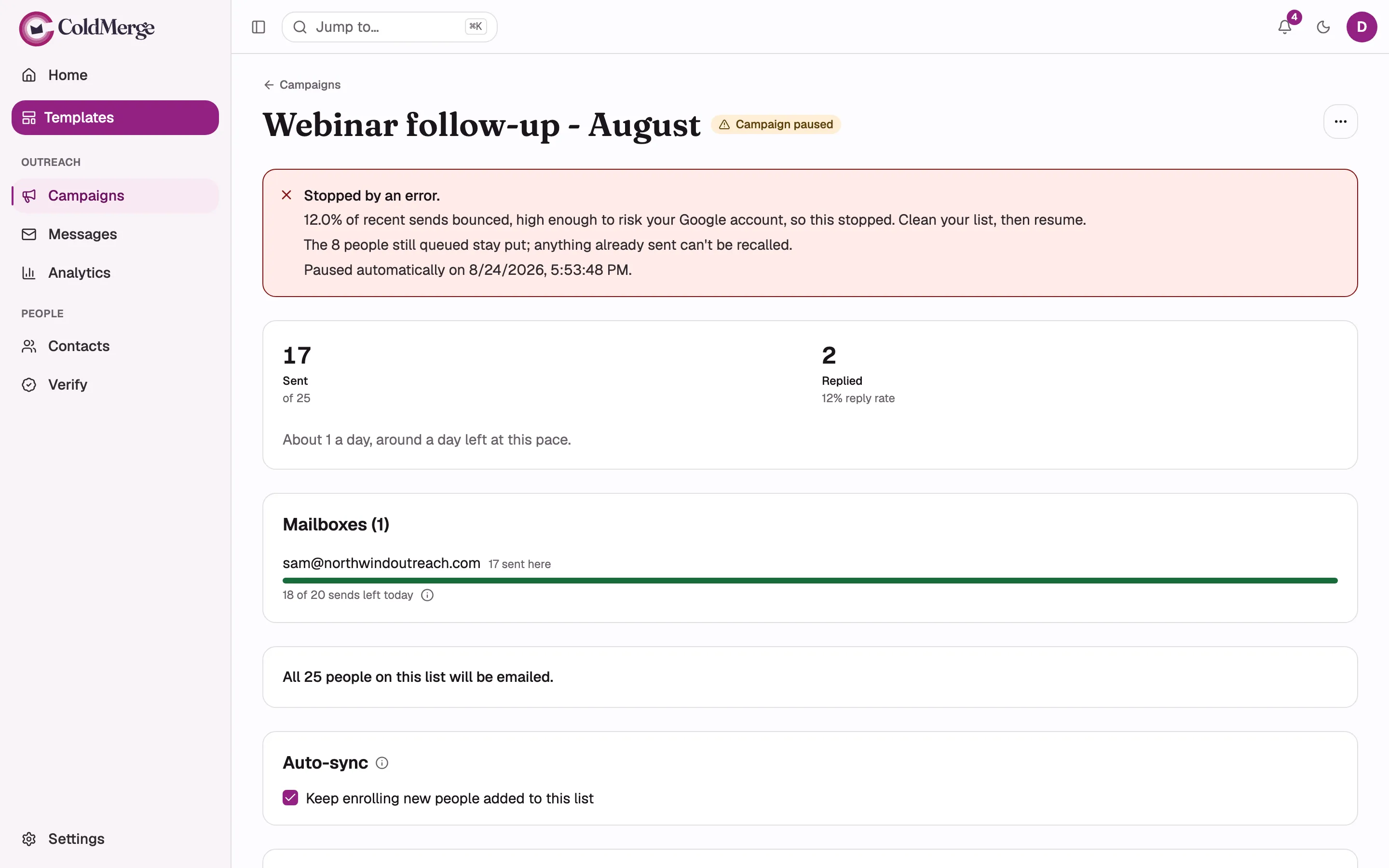
Why the pause does not lift itself
Section titled “Why the pause does not lift itself”Most pauses in ColdMerge are derived. A campaign held up by a disconnected mailbox or a lapsed subscription resumes on its own the moment the cause is gone, with no ceremony.
The bounce pause is different. It latches, and only an explicit click from you clears it.
The reason is a nasty piece of arithmetic. The moment a campaign stops sending, no new bounces arrive. The trailing rate therefore decays back under 10% purely because nothing is happening. A self-clearing pause would resume into exactly the same dirty list, bounce again, trip again, and flap back and forth forever while steadily damaging your domain.
So the pause is a stored state that waits for a human.
Before you press Resume
Section titled “Before you press Resume”Resuming is one plain click, and ColdMerge does not force you to clean the list first. But it does give you a hard warning, and the warning is not decoration.
Sustained high bounce rates get real Gmail and Workspace accounts suspended by Google. Not throttled. Suspended. That is your actual mailbox, the one your customers and colleagues write to, and it is not something ColdMerge or anyone else can appeal on your behalf.
Resuming a campaign that tripped the circuit breaker, without changing the audience, means sending more mail to the list that produced a 10% bounce rate. It will keep bouncing. The odds do not improve because you clicked a button.
What actually helps, roughly in order:
- Look at where the list came from. Scraped, bought, or years old is the usual answer, and no amount of tuning fixes it.
- Verify the remaining addresses. ColdMerge can check them before you send, which tells you how much of the list is dead without spending your reputation to find out. Verification informs rather than suppresses, so you stay in control of what happens next. See Replies, tracking and verification.
- Build a smaller, better list. A hundred people you can name beats ten thousand you cannot.
Then start a fresh campaign to the cleaned audience rather than resuming the old one.
Related
Section titled “Related”- How ColdMerge sends explains why a bounce writes a suppression row nothing can bypass.
- Unsubscribes and suppression covers the suppression list itself, including which entries can be removed.
- Contacts, lists and imports covers building and cleaning an audience.