Contact details, custom fields, and removal
Selecting a contact opens their own page. The address is the heading, the fields you can merge into a message are in the middle, and the two ways to remove them are at the bottom.
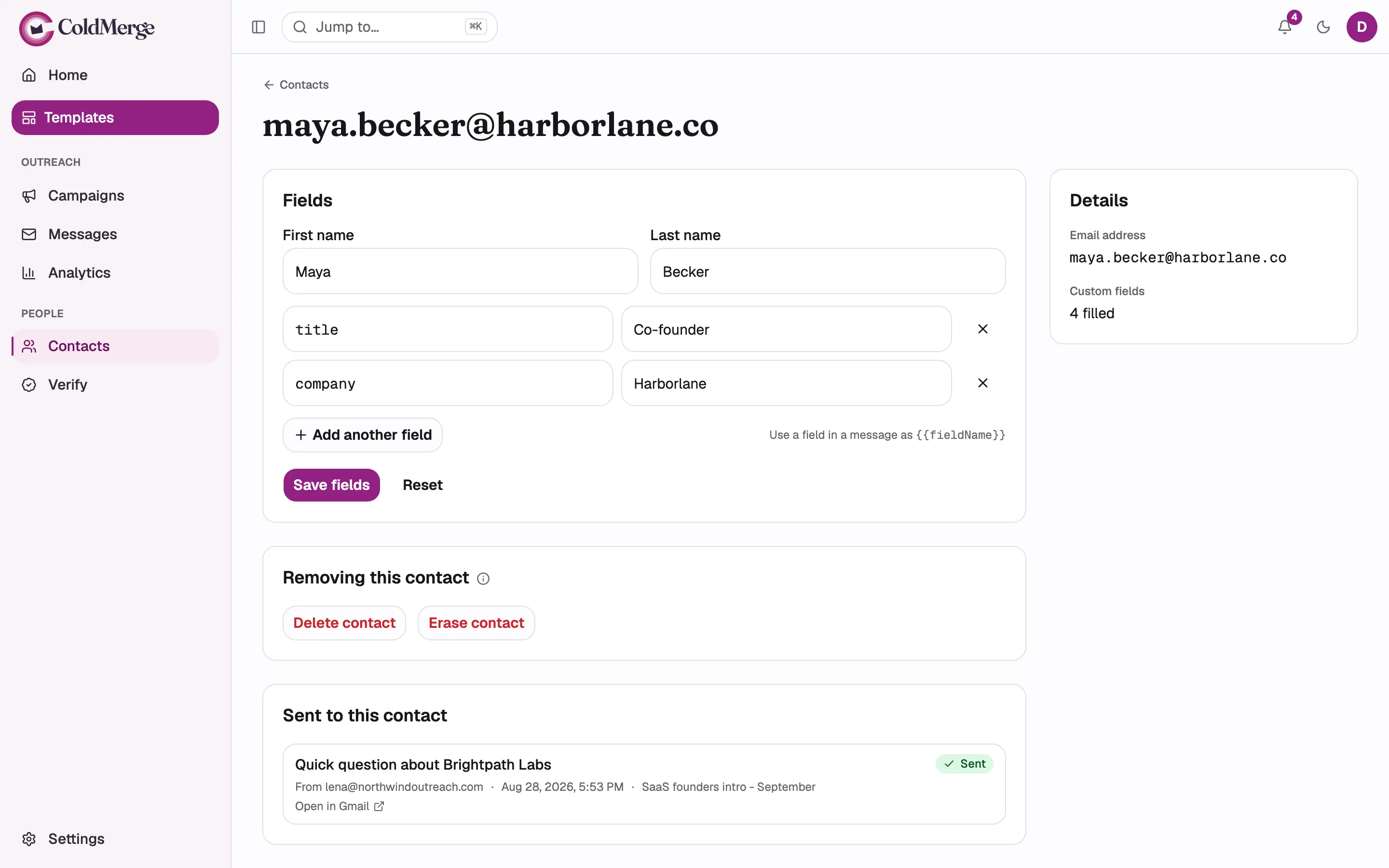
Edit custom fields
Section titled “Edit custom fields”The Fields section holds everything ColdMerge knows about this person besides their address.
- First name and Last name are offered on every contact. They are a convention, not a requirement, and leaving them empty is fine.
- Select Add another field for anything else: a company, a job title, a city. Each extra field is a name on the left and a value on the right.
- Select Save fields.
Reset puts every box back to what was last saved. Nothing is written while you type.
Use any field in a message as {{fieldName}}, matching the name exactly,
including capital letters. See
campaigns and sequences for merge token syntax
and fallback values.
Three things are refused when you save:
- A row with a value but no name. Give every field a name.
- An extra field named
firstNameorlastName. Those are the two boxes above. - Two extra fields with the same name.
A standard field you leave empty is simply not stored. An empty field and a missing field behave the same way in a message.
The Details panel on the side repeats the address and counts how many fields are filled in.
Read what you have sent
Section titled “Read what you have sent”Sent to this contact at the bottom of the page lists every message ColdMerge handed to Gmail for this person: the subject, its status, which mailbox it came from, which campaign it belonged to, and when it was attempted.
ColdMerge never stores message bodies. Gmail holds those, in the Sent folder of the mailbox that sent them.
Delete or erase
Section titled “Delete or erase”The Removing this contact section holds two different actions. They are not two words for the same thing.

Delete
Section titled “Delete”Delete contact is ordinary cleanup for somebody you have never written to. It removes the contact and their fields, and adds nothing to your suppression list. Anyone in your workspace can do it.
If the person has message history, the delete is refused. The buttons are replaced by an explanation naming how many messages are on record, and telling you they can be erased but not deleted. Leave them alone puts the section back the way it was.
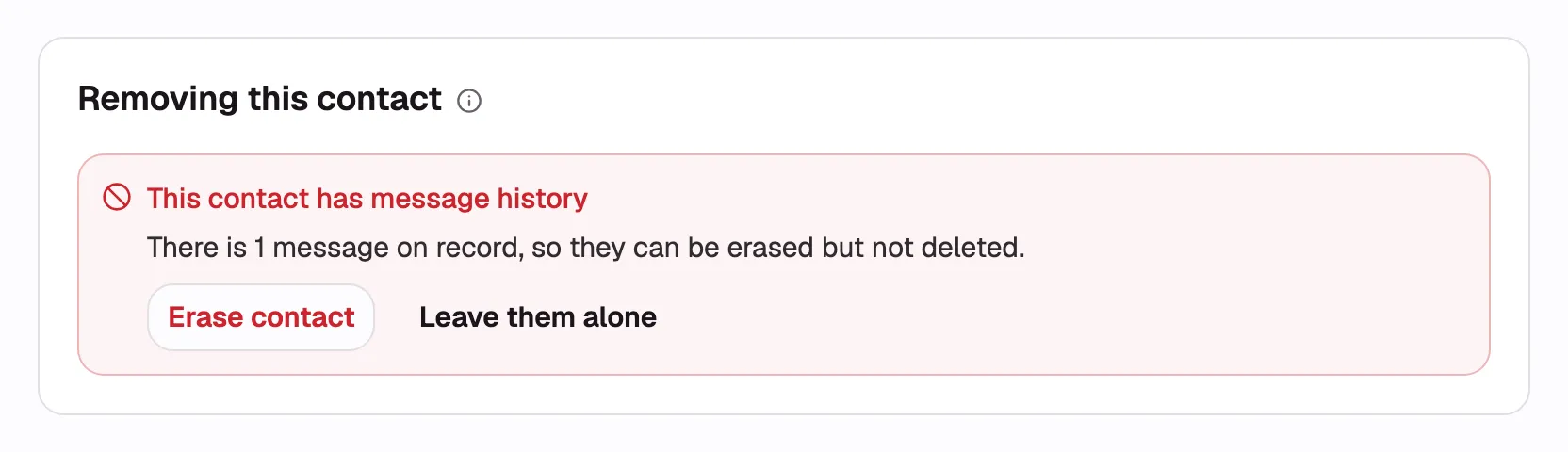
That refusal is the point of the rule. Deleting someone you have emailed would throw away the record of what you sent them, and leave nothing behind to stop them being re-imported and emailed again.
Erase contact honors a request to be forgotten. It deletes the person’s fields and their message history for good, and cannot be undone by anyone.
What erasing keeps is one thing: a one-way hash of the address. A hash is a scrambled fingerprint that cannot be turned back into the address it came from. ColdMerge keeps it so the person stays on your suppression list forever, even though their record is gone. If that address is ever imported again, it is skipped.
Erasing reaches every copy of the address, including rows sitting in a file you started importing and never applied.
Only an Owner or an Admin can erase. A Member who runs into the delete refusal is told “Only an Owner or Admin can erase.”
If the person was already on your suppression list for another reason, that original reason is kept. The confirmation message afterwards says which reason the remaining row carries.
Which one to use
Section titled “Which one to use”| Situation | Use |
|---|---|
| A junk row from a bad import, never emailed | Delete |
| A duplicate you created by hand, never emailed | Delete |
| Someone who asked to be forgotten | Erase |
| Someone you have emailed, for any reason | Erase |
Deleting many people at once is possible from the Contacts table. It skips anyone with message history and reports how many it kept. See find, add, and act on contacts.