Write your campaign
This page walks the draft editor, the screen you land on when you press New campaign. Nothing you do here sends anything. A draft can be deleted at any time and your list and contacts are untouched.
Start the draft
Section titled “Start the draft”- Open Campaigns and press New campaign.
- You land straight in the editor. No campaign record exists yet. It is created the first time you press Save, and the address bar then changes to that campaign’s own page.
If you want to begin from something you have written before, use the Start from template picker, which appears only on a brand new campaign. See Reuse a message with templates.
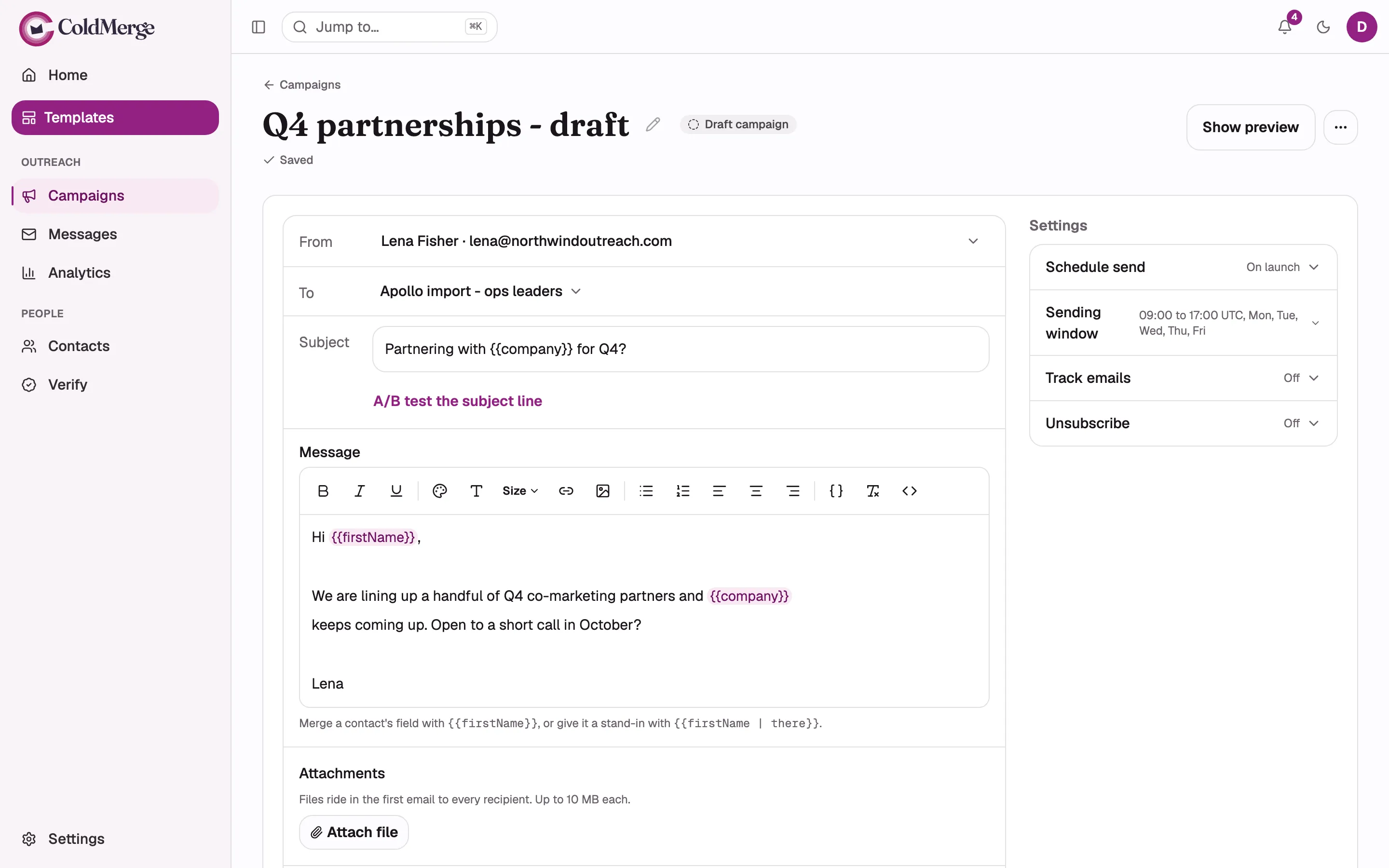
Fill in the compose card
Section titled “Fill in the compose card”The card reads top to bottom like an email.
Pick one or more connected mailboxes in the From row. ColdMerge rotates across the mailboxes you choose, deciding which one sends to a given person at the moment of sending, not at launch. There is no forecast of the split before you start.
A contact is bound to whichever mailbox first emails them, and every follow-up to that person then goes from that same mailbox, so the conversation stays in one place.
If a mailbox you picked is blocked by a domain health problem, the editor names it and links you to the sending domain so you can fix the DNS record.
Choose the list this campaign is aimed at in the To row. Choosing does not write anything. It is saved with the rest of the card when you press Save.
The list you aim at is a draft-only choice. Once the campaign leaves draft it is shown but frozen, and cannot be re-aimed.
If the list is archived, the editor warns you inline.
Subject
Section titled “Subject”Type the subject in the Subject row. It can carry merge tokens, for example
A question about {{company}}.
To test more than one subject line, press A/B test the subject line. The subject you already typed becomes Variant 1 and you add the rest as Variant 2, Variant 3, and so on. ColdMerge allows up to 5 subject lines in total, so up to four extra variants.
How the test behaves:
- Recipients are split evenly and at random at launch.
- Each person keeps their variant, so their follow-ups thread under it.
- Reply rate is reported per variant.
Press Turn off to drop the extra variants and go back to one subject line.
Write the message in the editor below the subject. There is no plain text versus HTML picker. ColdMerge decides the format from what you actually wrote:
- If the body has any formatting mark (bold, italic, underline, a link, colour, a font), any list, a heading, or non-default alignment, the message sends as HTML.
- Otherwise it sends as plain text.
- Turning on open or click tracking also forces HTML, because tracking needs a rewritten link or a pixel.
Raw HTML is reachable through the <> code view if you need it.
Merge tokens go in the body as well as the subject. The exact syntax is on the merge token reference.
Attachments
Section titled “Attachments”Press Attach file under the body to add a file.
- Up to 10 MB per file.
- At most 10 files on one campaign, and at most 20 MB across all of them.
- Files ride the first email only. Follow-ups never carry attachments.
- Attachments can only be changed while the campaign is a draft. They lock the moment it leaves draft.
Set the sending options
Section titled “Set the sending options”Under the message are three settings rows.
Sending window is the working days and hours this campaign may send in. It starts from your organization’s default and becomes this campaign’s own from then on. The default is 09:00 to 17:00, Monday to Friday. A window is set in a named time zone and can never wrap past midnight. Daily send limits per mailbox are not set here. They live on Connected accounts.
Track emails turns on click tracking and open tracking. Both are off by default, and both need a verified tracking domain of your own. If you do not have one, the row explains that and links to Set up tracking. Turning either one on sends the campaign as HTML. Your unsubscribe link is never tracked.
Open tracking is labelled unreliable on purpose. Apple Mail Privacy Protection inflates opens and the pixel can hurt deliverability. Reply rate is the number that matters.
Unsubscribe is not a per-campaign setting. The row reflects your organization-wide footer setting and links to where it is changed.
Save your work
Section titled “Save your work”The editor never writes on a keystroke. Your edits are staged until you press a button:
- Save writes everything on the card at once.
- Reset throws the staged edits away and puts back what was last saved.
This matters for previews too. A preview send always uses the last saved message, so save before you preview. See What a preview send really does.
Add follow-ups
Section titled “Add follow-ups”The follow-up editor sits directly under the compose card, joined to it. Adding follow-ups is covered on How follow-up sequences work.
When you are ready
Section titled “When you are ready”Press Continue to review. That opens the launch wizard. It does not send anything. The button stays disabled while you have unsaved edits, because the launch freezes what is saved, not what is typed.
See Launch a campaign.