Monitor and control a running campaign
Once a campaign is scheduled or sending, its page turns into a monitoring view. Everything you need to watch works on a phone. The levers that operate the sending machine are on a computer, apart from one.
Read the numbers
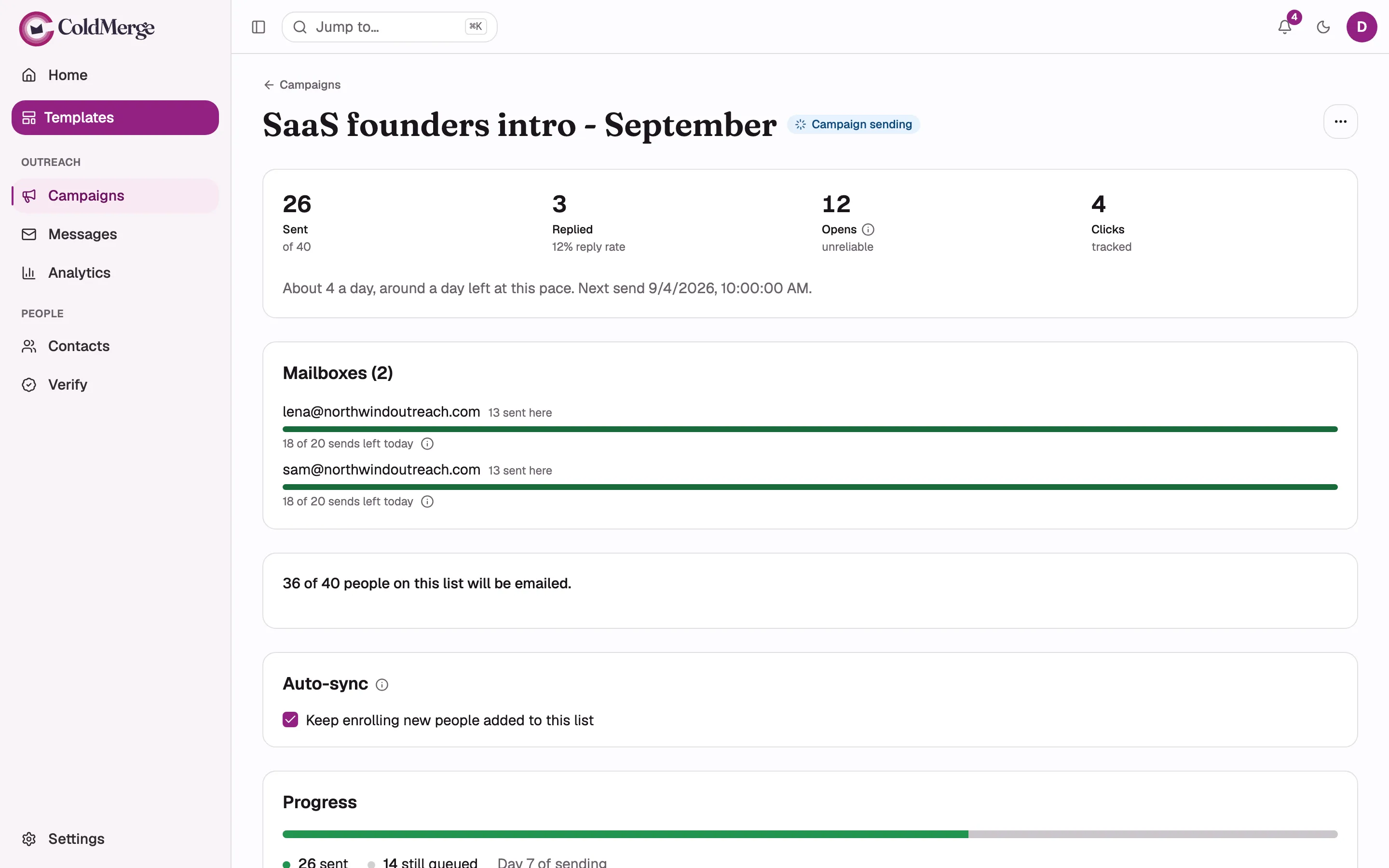
Section titled “Read the numbers”The top of the page is a row of big numbers.
- Sent, out of the size of the audience.
- Replied, with the reply rate beside it. This is the number that matters for cold outreach.
- Opens and Clicks, only if you turned tracking on. Opens are labelled unreliable on purpose. Apple Mail inflates them and the pixel can hurt deliverability. Read them as a rough secondary signal, never the headline.
Under the numbers is a pace line, something like “About 40 a day, around 3 days left at this pace.” Remaining days are always an estimate and are always labelled as one. Elapsed days are a fact. The estimate counts sending days only, so a weekend under a Monday to Friday window does not count against it.
The same line names when the next send is due, or names what is stopping one: every mailbox has hit its daily limit, more mailboxes are connected than your plan allows, or the window never opens.
A campaign too big to finish today simply continues tomorrow. That is ordinary progress, not a failure.
Further down, Progress breaks the audience into states, and Recipients lists people one by one. Filter that table by state: all, sent, sending, queued, failed, skipped, or cancelled. A skip is the system working, not an error, so it is shown in a neutral tone with its reason: unsubscribed or suppressed, missing a merge field, already queued in another campaign, or flagged dead by your check.
Read the banners
Section titled “Read the banners”Banners sit above the numbers and say what state the campaign is really in.
Scheduled
Section titled “Scheduled”“Scheduled to start” plus the resolved first send time. Nothing has gone out yet. You can still edit the first email, reschedule, or cancel.
Paused
Section titled “Paused”There are two very different pauses, and they use different words.
“Paused. Nothing new is being sent.” means a person pressed Pause. The banner names who and when. The people still queued stay put, and anything already sent cannot be recalled.
“Stopped by an error.” means ColdMerge stopped the campaign itself, and the banner names the reason. The reasons you may see:
| Reason | What it means |
|---|---|
| Bounce rate | Too many of the recent sends bounced, high enough to risk your Google account. Clean your list, then resume. |
| Empty message body | The body is empty, so sends would arrive blank. Duplicate the campaign, fix the body, and relaunch. |
| Unsubscribe footer lost | The required footer was lost, so nothing sent. Check the end of your message for unclosed markup. |
| Consecutive failures | Several sends failed in a row. Check recent messages for the reason, then resume. |
A bounce-rate pause latches. It does not clear itself when the rate improves. Only you can clear it.
Paused because of billing
Section titled “Paused because of billing”“Sending is paused because billing is not up to date”, with a Go to Billing link. This is a different thing from a manual pause. Your organization has fallen out of good standing, so nothing is handed to Gmail. The queue stays put and sending resumes on its own once the account is paid up.
This state is worked out live rather than stored, so it clears the instant billing is settled. On the campaigns list it shows as a Paused, billing chip.
Cancelled
Section titled “Cancelled”“Cancelled. This campaign will not send again.” The people who were still waiting are never emailed. Anyone already sent to keeps what they got.
No mailbox to send from
Section titled “No mailbox to send from”If every mailbox this campaign uses needs reconnecting, or none is selected, a banner says so. The rest of the audience stays queued and sending resumes once a mailbox is back.
Pause and resume
Section titled “Pause and resume”Pause stops the next send. Anything already in flight still goes out. Pausing never unsends anything.
Resume picks up where the campaign left off, oldest due first, under the ordinary budget, window, and pacing.
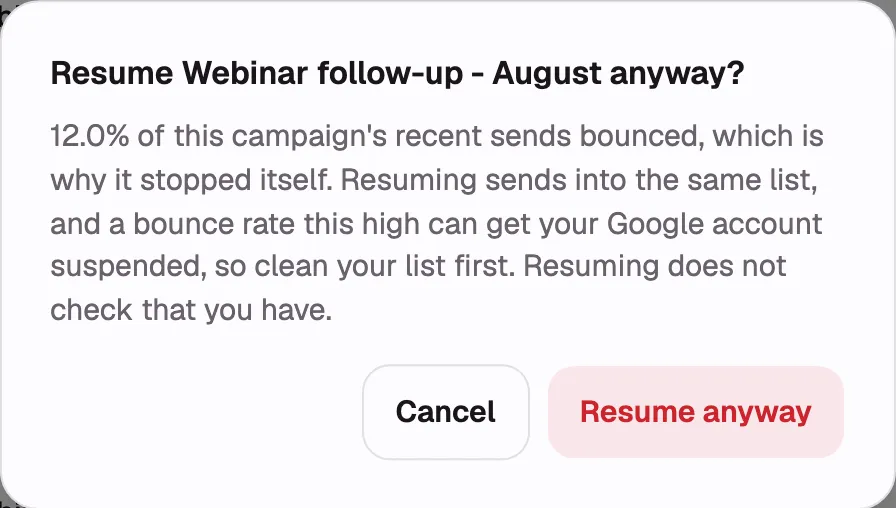
One resume is different. A campaign that stopped itself over its bounce rate asks you to confirm first, in a dialog that names the actual bounce rate and warns that a rate this high can get your Google account suspended. Clean your list before you confirm. Resuming does not check that you have. The confirm button reads Resume anyway.
Starting, pausing, resuming, and rescheduling are done on a computer. On a phone the page says so.
Cancel, and how it differs from delete
Section titled “Cancel, and how it differs from delete”Delete campaign exists only while a campaign is a draft or in review. Nothing has been sent, so there is nothing to keep a record of.
Cancel campaign replaces it from scheduled onwards. Once real people have been emailed, the campaign is a record of what happened and is kept.
Cancelling asks you to confirm. It tells you how many people are still waiting and will now never be emailed. Messages already sent cannot be recalled, and a cancelled campaign cannot be restarted.
Cancel is the one consequential control ColdMerge gives you on a phone, because it is the one thing you might need in a hurry, away from your desk.
What you can still change
Section titled “What you can still change”Three groups of settings behave differently once a campaign leaves draft.
| Group | Fields | When you can change it |
|---|---|---|
| First email | Subject, subject A/B variants, body, body format, open and click tracking | Until the very first send goes out. Frozen from then on, for the rest of the campaign’s life. |
| Forward only | Campaign name, sending window, which mailboxes send | Any time until the campaign is completed or cancelled. |
| Audience | Which list the campaign is aimed at | Draft only. Locked the moment it leaves draft. |
A few consequences worth spelling out:
- A scheduled campaign has not sent anything yet, so its first email is still editable. It locks at the first real send, not at launch.
- Once the first email locks, the page says “Sending has started, so the first email is locked. Duplicate to a new draft to change it.” and offers a Duplicate to a new draft button. That is the way to change the message.
- The list is shown but frozen, with the note “Set at launch and cannot be re-aimed. New list members still flow in while auto-sync is on.”
- You cannot remove the last remaining mailbox from a sending or paused campaign. Something has to send.
- Attachments lock when the campaign leaves draft.
- Follow-up steps are not in any of these bands. They stay editable for the whole life of a running campaign. See How follow-up sequences work.
If an edit is refused, ColdMerge names which rule refused it and why, rather than showing a generic error.
Editing a running campaign is done on a computer. On a phone the same page shows the settings read-only.