Plans and billing
Billing lives at Settings, then Billing, in the Workspace group. The menu describes it as “Your plan, standing, and invoices”, and the page itself opens with one line: “Cards and invoices live on Stripe.”
That line is the most useful thing on the screen. ColdMerge keeps your plan, your status, and your renewal date. Stripe keeps your card, your receipts, and your invoice history. Anything to do with money changing hands happens on Stripe’s own pages.
Subscribing and changing plans are Owner and Admin actions. Everyone else sees the plan and the standing but no buttons.
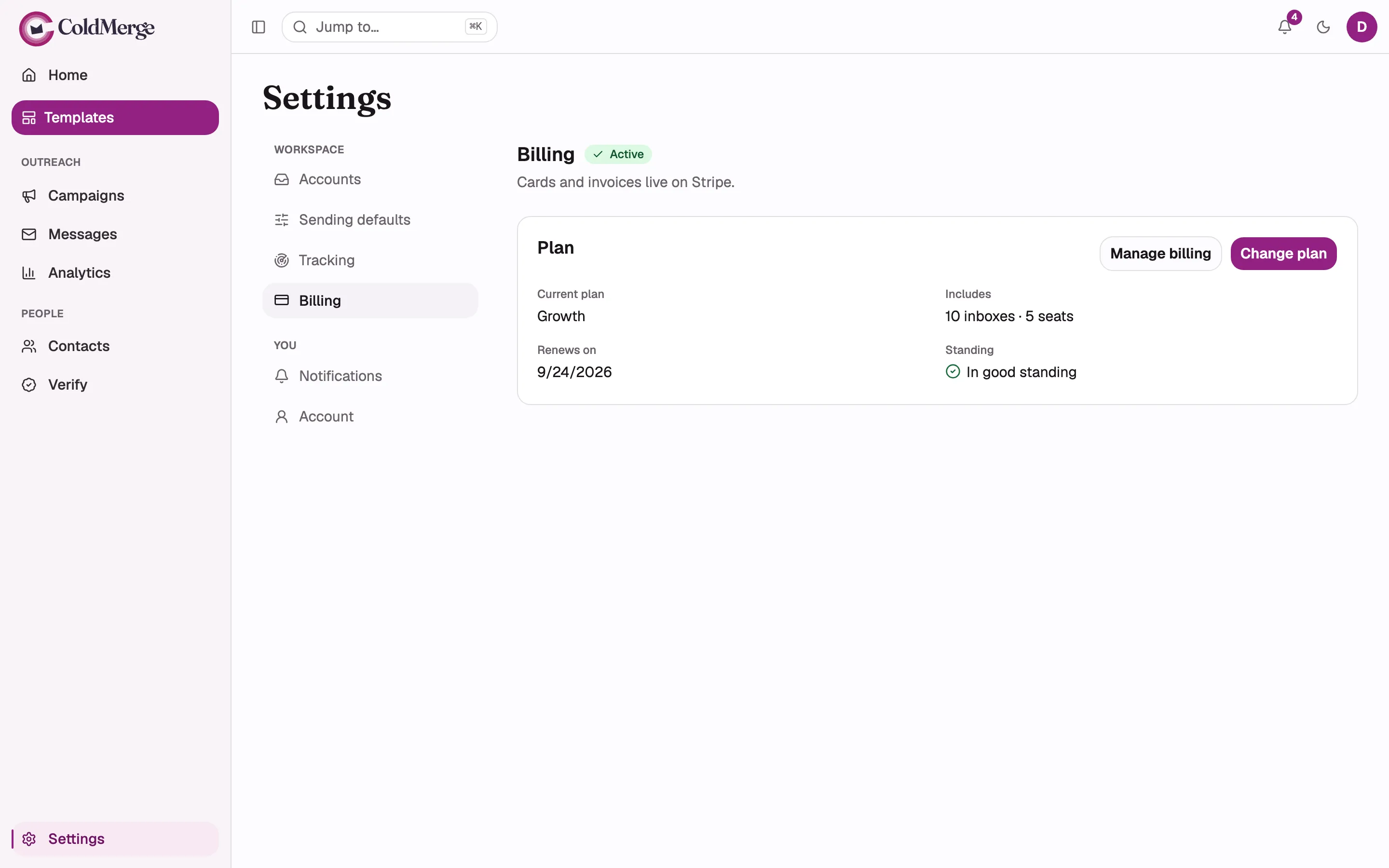
Read the Plan panel
Section titled “Read the Plan panel”The Plan panel is a short list of facts.
- Current plan: the bundle’s name, or “Custom” followed by its inbox count, or “Beta access” if your workspace was granted everything free, or “No plan” if you have not started one yet.
- Includes: how many inboxes and how many seats the plan allows. A comped plan reads “Everything included” instead of numbers.
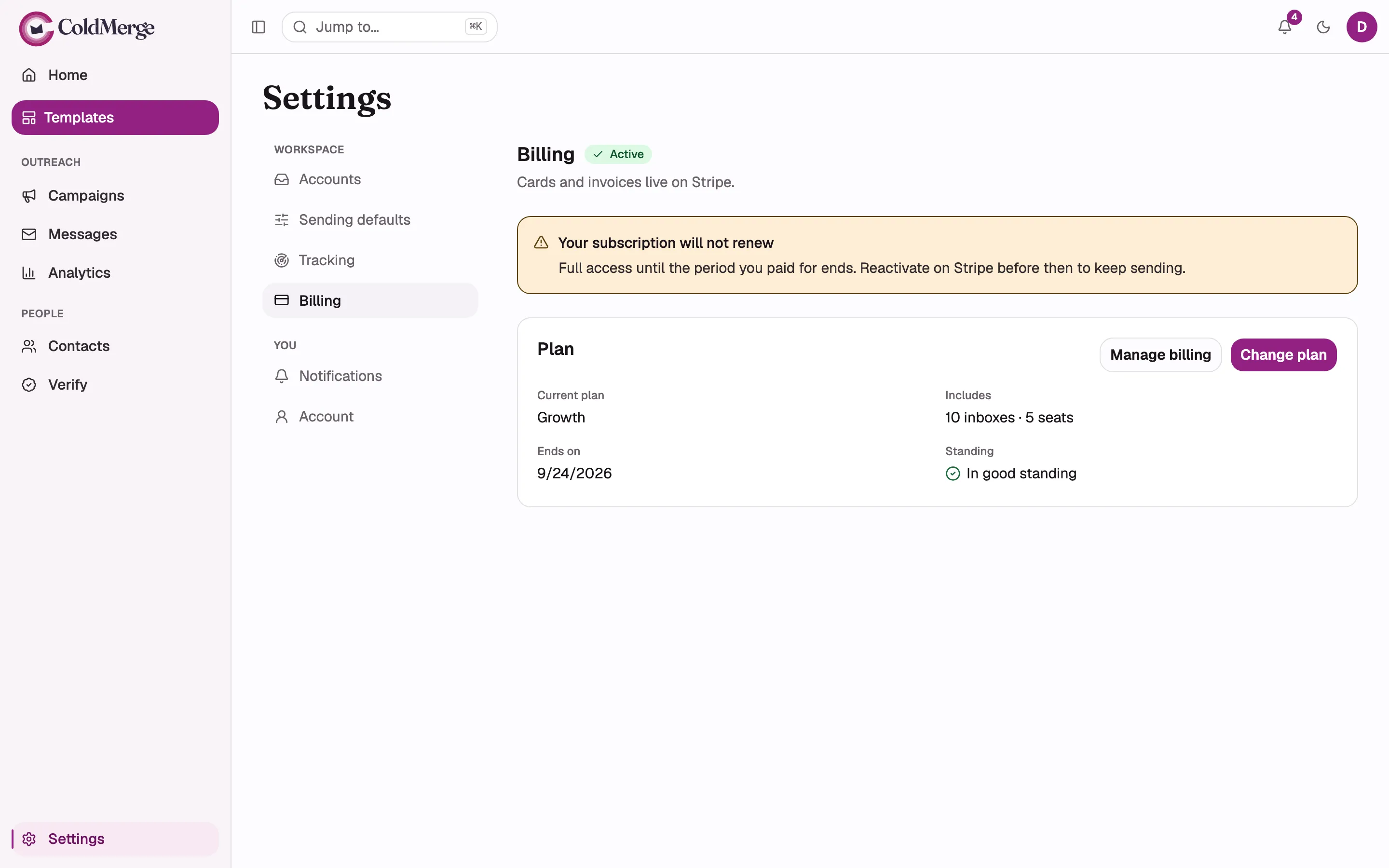
- Renews on, or Ends on if you have cancelled: the date the current paid period runs out.
- Standing: “In good standing” with a tick, “No plan yet, sending unavailable” if you have not started one, or “Not in good standing” with an alert icon.
A status pill sits in the header above the panel: No plan, Beta access, Trial, Active, Payment past due, or Lapsed. While the Trial pill shows, sending is bounded twice across the whole workspace, combined across every mailbox and campaign: an allowance for the whole trial, and a separate limit on how much of it you can spend in one day. The Terms version in force when you signed up sets the trial allowance, and it depends on the account: 500 recipients across the whole trial, or 100 where those Terms allow a smaller one for a new account that costs nothing to mint, such as one opened on a free mail address or on a domain registered in the last thirty days. You do not have to work out which applies to you, because the Sends left row below states your own allowance. The daily limit is 100 recipients, which is the same number as the smaller allowance without being the same rule: the daily one resets at UTC midnight, and the trial allowance does not come back, so an account on the smaller allowance could spend its whole trial in a single day. Both lift the moment the trial converts to a paid plan.
The trial: it starts by itself, with no card
Section titled “The trial: it starts by itself, with no card”You do not start the trial, and there is no button for it. Signing up starts it: with Google you are trialing before you reach Home, and with an email address and password it starts when you confirm the address, so time spent in your inbox costs you no trial days. You are never sent to a payment page to begin something free.
For a few seconds after you arrive, Billing may say “Your trial is being set up”. That is the trial being created; the page updates itself and there is nothing to do.
The 14-day trial wears the plan you arrived with rather than a trial plan of its own, so it runs at that plan’s inbox count: start from the Growth link on the pricing page and your trial connects up to 10 mailboxes, start from Starter’s and it connects 3. Sign up without naming a plan and the trial is Starter. The Plan panel above names the one you are on. Whichever it is, the trial keeps the two limits of its own, the send allowance above and the 100 a day, and it withholds nothing else its plan includes.
While the Trial pill shows, the Plan panel replaces the usual “Renews on” row with four of its own:
- the date the trial ends
- Days left
- Sends left, as what is left of your trial’s own send allowance, stated as the remainder and the allowance together
- Card on file, or No card on file
Home shows the same two numbers in one line above the page. It reads as a plain fact for most of the trial and turns amber only once one of them is genuinely low, so the line is worth reading when it changes colour.
When no card is on file, two controls sit under those facts, with a Billing term choice (Monthly or Yearly) above them. They are deliberately different sizes, because they do different things:
- Add a card is the ordinary button, and it is the one most people want. It hands you to Stripe to enter a card and a billing address. Your remaining free days are untouched: the trial keeps running exactly as before and converts to a paid subscription when it ends, charged automatically.
- Start paying now is the quieter text link beside it. It ends the trial as soon as the payment goes through, so you are charged today. Both controls ask you to confirm first, and the confirmation says which of the two you pressed, so nobody is charged early by accident.
The term is asked for here and nowhere else during the trial, because it is the first moment money is involved. If you add a card and never choose a term, you are billed monthly when the trial converts: no annual commitment is ever created silently. (A trial that reaches its end with no card at all does not convert; it is cancelled, as below.)
Backing out at Stripe costs you nothing. Nothing is collected until that page is finished, so an abandoned payment leaves your trial exactly as it was.
If the trial ends with still no card on file, Stripe cancels the trial on its own. See What happens if a payment fails for what that looks like and how to come back from it.
What standing means
Section titled “What standing means”Standing is a plain yes or no: can this workspace send mail right now?
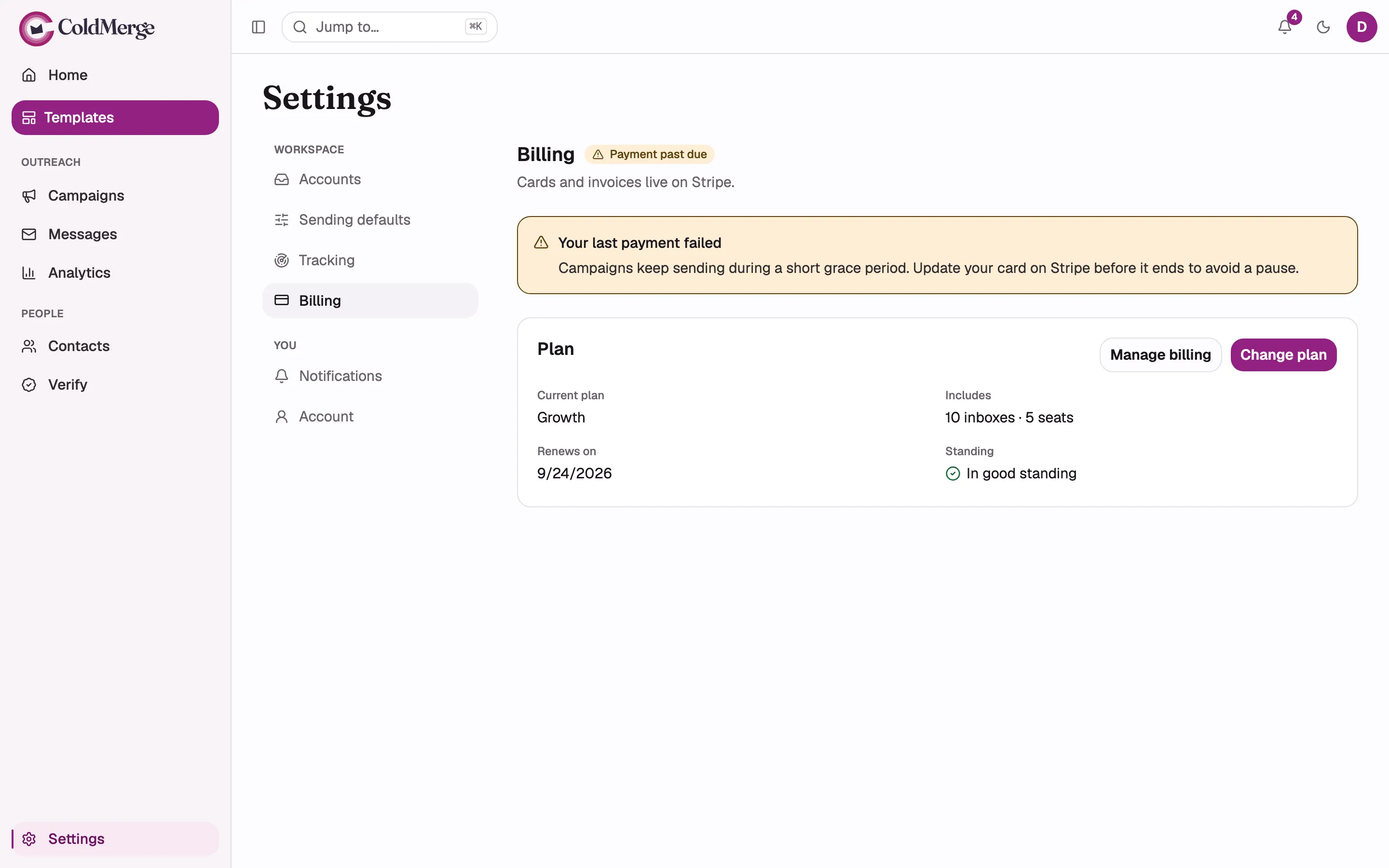
“In good standing” covers a comped workspace, a trial, an active subscription, and a subscription whose last payment failed but is still inside its grace period. All of those keep sending.
“No plan yet, sending unavailable” means this workspace has never started a plan. Everything else works: connect a mailbox, import contacts, build and launch a campaign, and send a preview to either of the two addresses you have proved you own, which are your own account address once it is verified and the sending mailbox’s own address (see What a preview send really does). Sending starts when you choose a plan.
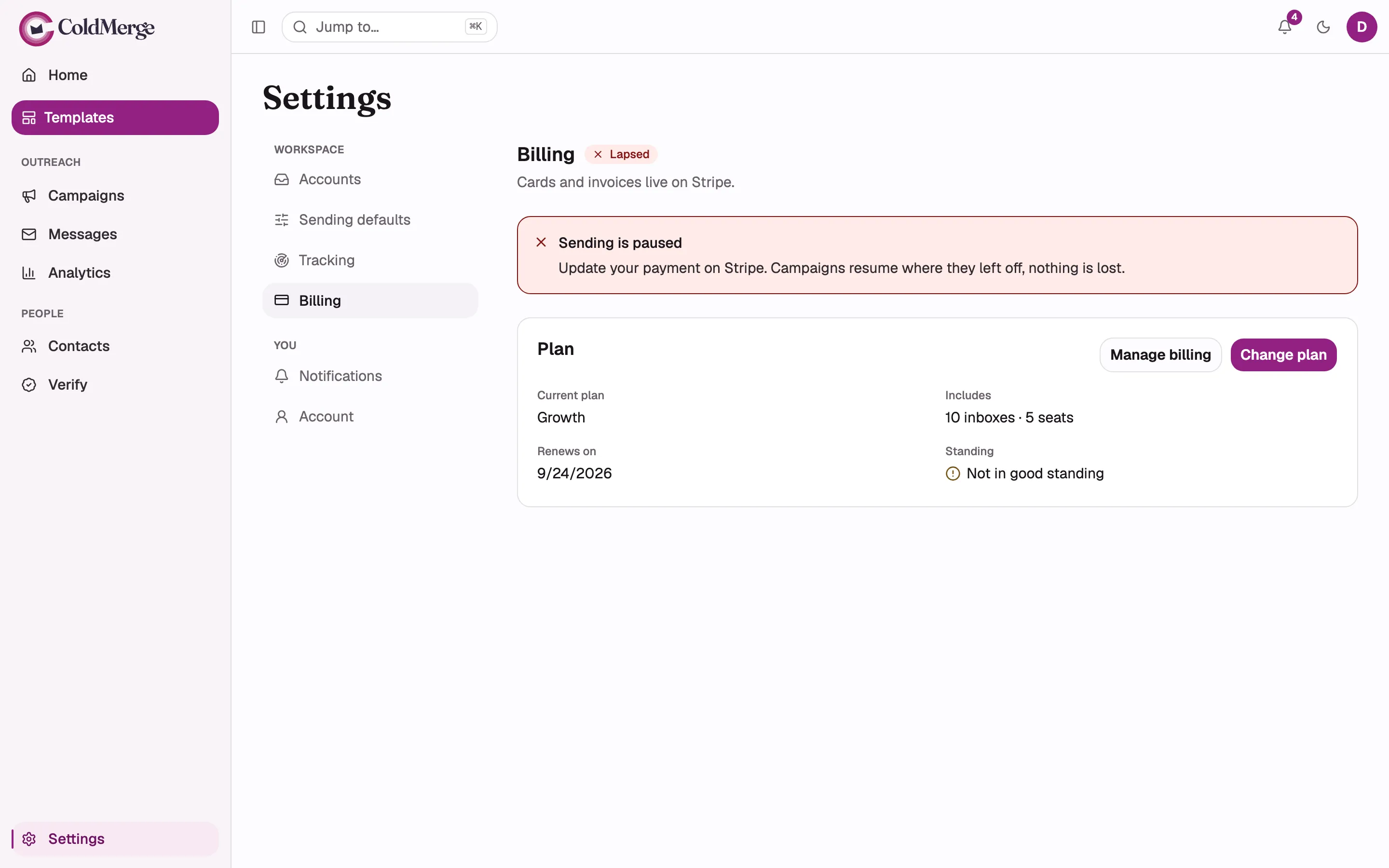
“Not in good standing” means the subscription has lapsed, and sending is paused. See What happens if a payment fails.
The warning banners
Section titled “The warning banners”Warnings sit at the very top of the Billing screen, loudest first. You may see more than one at a time.
| Banner | Colour | What it means | What to do |
|---|---|---|---|
| You don’t have a plan yet | Amber | This workspace has never started a plan. Everything works except sending. | Select Subscribe in the Plan panel when you are ready to send. |
| Sending is paused | Red | The subscription is no longer active. Nothing is going out. | Start a subscription again. Campaigns resume where they left off, nothing is lost. |
| Your last payment failed | Amber | A card was declined. You are inside the grace period, and campaigns keep sending. | Update your card on Stripe before the grace period ends, to avoid a pause. |
| Your subscription will not renew | Amber | You cancelled. You keep full access until the period you paid for ends. | Reactivate on Stripe before then if you want to keep sending. |
If the lapse was your free trial ending without ever adding a card, the red banner carries one more line: “Your free trial ended. Subscribe to resume sending; your campaigns and contacts are exactly as you left them.” Select Subscribe in the Plan panel: it opens Stripe’s checkout, collects a card, and picks up right where the trial left off, with no second trial.
Manage billing on Stripe
Section titled “Manage billing on Stripe”Select Manage billing in the Plan panel header. It hands you to Stripe’s hosted customer portal, which is where you:
- change or add a card
- download receipts and past invoices
- see your billing history
- reactivate a subscription you cancelled
The button appears once your workspace has a Stripe customer record, so a workspace that has never subscribed does not see it. Stripe’s portal works fine on a phone.
Tax is worked out and collected at checkout, so what you approve is what you pay.
Choose a plan
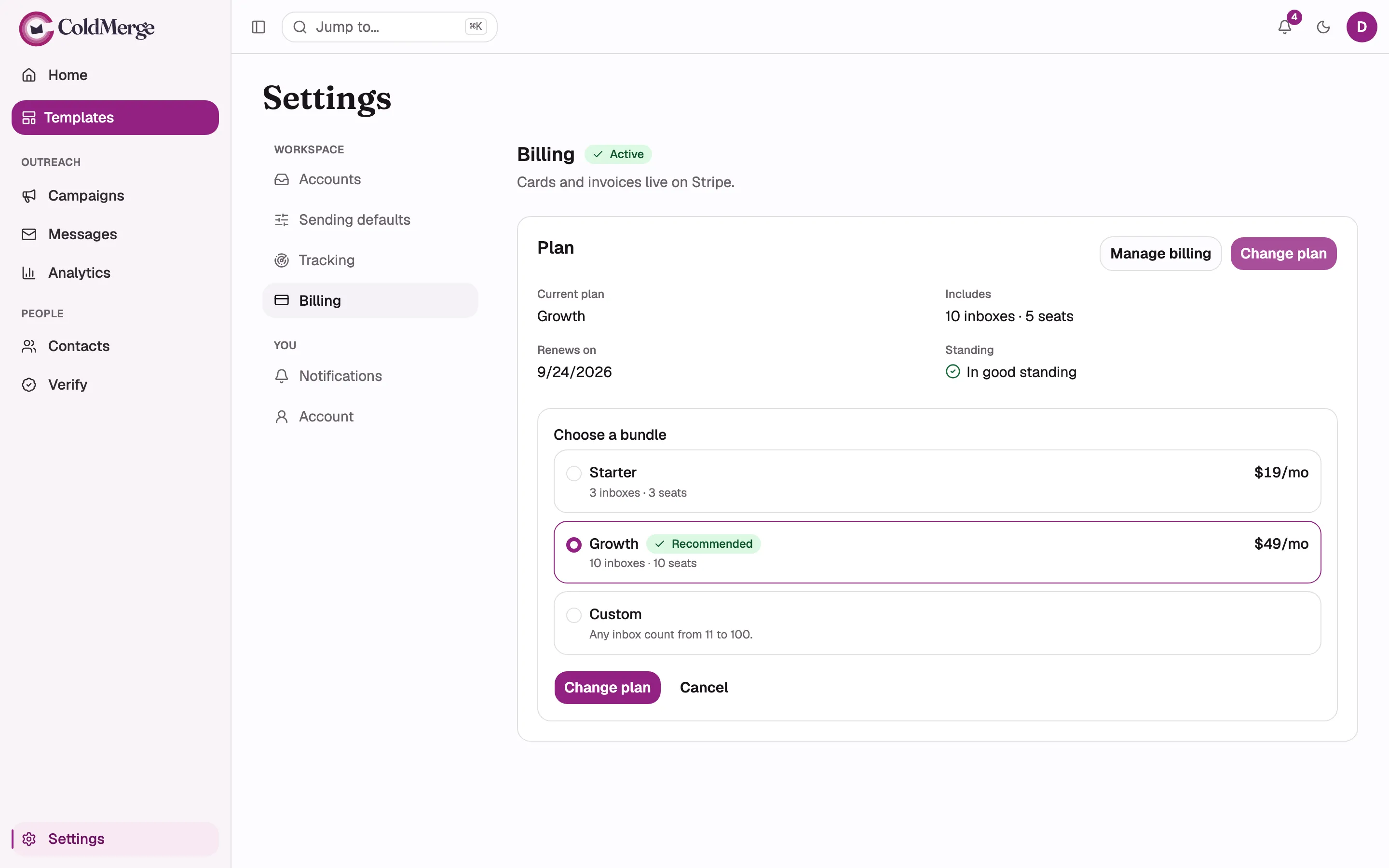
Section titled “Choose a plan”Select Subscribe if you have never subscribed, or if your subscription has lapsed (including a trial that ended without a card), or Change plan if you have an active subscription already. Both open the same panel.
This panel is desktop only. On a phone you get a one-line summary and an invitation to open it on a computer. Picking a plan is a decision with money attached, so ColdMerge asks for a real screen.
Bundles
Section titled “Bundles”Each bundle option shows its name, its monthly price, and how many inboxes and seats it includes. One bundle carries a green Recommended badge.
Prices are read live from ColdMerge’s pricing source, so the number beside a bundle is the number checkout charges.
At the time of writing there are two bundles: Starter, with 3 inboxes and 3 seats, and Growth, with 10 inboxes and 10 seats. Growth carries the Recommended badge. The panel itself is always the live list.
Custom
Section titled “Custom”Pick Custom if the bundles do not fit. It opens a slider for an exact inbox count, along with the seats that count includes. The price under the slider updates as you drag, showing a monthly total and a yearly total.
The slider has a ceiling. Above it, the panel says “Contact support” rather than letting you drag further, because a workspace that big is worth a conversation.
Monthly or yearly
Section titled “Monthly or yearly”The Billing term choice, Monthly or Yearly (discounted), appears only before you first subscribe. Yearly is described in the panel as two months free.
Once you are subscribed, the plan panel changes only the size of your plan, not its term. There is no in-app way to move an existing subscription between monthly and yearly; if you want to switch, contact support. The one moment a trialing workspace picks a term is beside Add a card and Start paying now, described above.
Finish with Continue to checkout, which hands you to Stripe. Checkout is always a payment: it charges you for the plan you chose, whether you are paying during a trial or resubscribing after one lapsed. Your free trial does not start here; it started when you signed up. Come back and you will see either “Subscription is being set up.” or, if you backed out, “Checkout cancelled. No plan was changed and you were not charged.”
Change your plan
Section titled “Change your plan”If you are already subscribed, the same panel’s button reads Change plan, and there is no checkout. ColdMerge saves the change and tells you when it takes effect:
- Adding inboxes applies now. You pay the prorated difference for the rest of the current billing period, and the extra inboxes are usable immediately.
- Removing inboxes takes effect at your next renewal. Your current, larger plan stays in place until then, and there is no refund for the part period.
The message you see after saving says which of the two happened, in those words.
Scheduled changes, and cancelling one
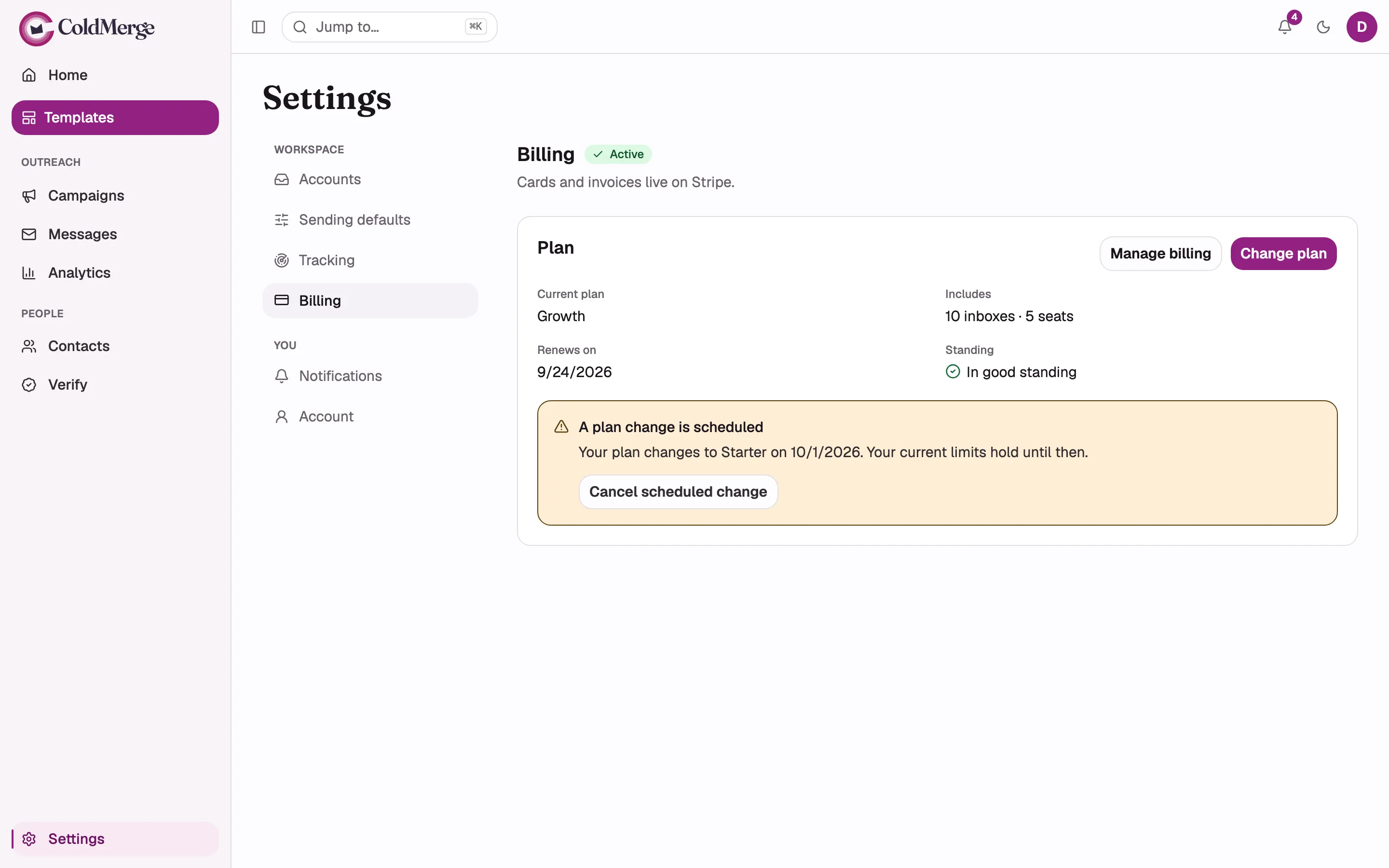
Section titled “Scheduled changes, and cancelling one”A downgrade waits, so the Plan panel shows an amber notice headed “A plan change is scheduled”. It names the plan you are moving to and the date, and adds: “Your current limits hold until then.”
To call it off, select Cancel scheduled change in that notice. Your plan stays exactly as it is, and the notice disappears.
What happens at your mailbox limit
Section titled “What happens at your mailbox limit”Your plan’s inbox count is a real limit, enforced in two places.
When you try to connect one too many. The Accounts page refuses the connect and says: “You have reached your plan’s mailbox limit. Upgrade to connect another.” Either upgrade, or disconnect a mailbox you no longer send from. See Connect and manage your mailboxes.
When a downgrade lands and you are over the new limit. ColdMerge does not disconnect anything. It parks the extra mailboxes: the oldest connected mailboxes keep sending, and the newest ones stop. That is worth reading twice, because the mailbox you connected most recently is the one that goes quiet, not the one you use least.
A campaign held up this way says so on its own screen: “Paused: more mailboxes connected than your plan allows. Upgrade or disconnect the extras to resume.”
Free up a slot, by upgrading or by disconnecting a mailbox you do not need, and a parked mailbox takes it automatically.
Seats behave differently. A seat limit is checked when you invite someone, so downgrading never throws an existing member out. You simply cannot invite anyone new until you are back under the limit.
Verification credits are elsewhere
Section titled “Verification credits are elsewhere”ColdMerge bills two separate things: this subscription, priced by inbox, and prepaid verification credits, which are pay as you go. Credits are bought and tracked in the Verification section, beside the balance they belong to, not on this screen. See Replies, tracking & verification.